
JEE Advanced Readiness Estimator
Based on historical data from the toughest papers, rate your current proficiency in these three critical areas.
Awaiting Input
Adjust sliders and click estimate to see your score.
Strategic Analysis
Every year, hundreds of thousands of students in India face the gauntlet of the Joint Entrance Examination (JEE) Advanced. It is widely regarded as one of the most difficult engineering entrance exams in the world. But among the years that have passed since its inception, which one stands out as the absolute hardest? If you are preparing for JEE Advanced, understanding the historical context of these papers can give you a strategic edge. It helps you realize what "tough" actually means in this context.
The question of "toughness" is subjective. For some, it is about complex calculations. For others, it is about unconventional problem statements or tricky concepts. However, when we look at data from coaching institutes, topper interviews, and official cutoff trends, a few specific years consistently rise to the top. This article breaks down those years, explains why they were difficult, and shows you how to use this knowledge to prepare effectively.
The Evolution of JEE Advanced Difficulty
To understand which paper was the toughest, we first need to understand how the exam has changed. The JEE Advanced is not a static test. Its format, syllabus weightage, and question types have evolved significantly over the decades. This evolution directly impacts perceived difficulty.
| Year/Era | Exam Structure | Key Characteristics |
|---|---|---|
| Pre-2013 (IIT-JEE) | Paper 1 & 2 (Objective + Descriptive) | High calculation intensity, descriptive answers required detailed steps. |
| 2013-2015 | Two Papers, Multiple Choice Questions (MCQ), Integer Type | Transition phase, focus on conceptual clarity over rote learning. |
| 2016-Present | Two Papers, Mixed Question Types (MCQ, Matrix Match, Paragraph-Based) | Emphasis on multi-concept integration, negative marking strategies crucial. |
In the early days, under the old IIT-JEE system, the difficulty lay in the sheer volume of calculations. You had no calculator, and problems often required simplifying complex algebraic expressions by hand. In recent years, the difficulty has shifted towards conceptual depth. Questions now often combine Physics, Chemistry, and Mathematics in ways that require lateral thinking rather than just formula application.
The Contenders: Years That Broke Records
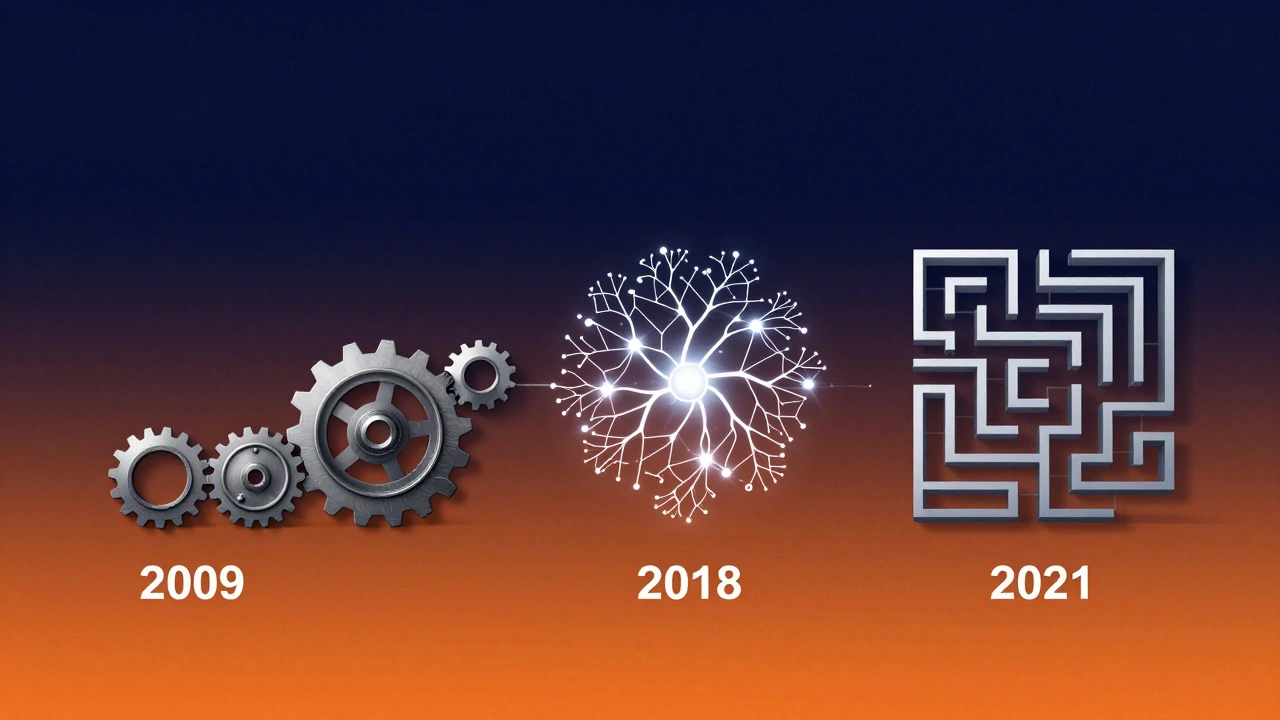
While every student finds different topics hard, three years stand out in the collective memory of aspirants and educators alike: 2009, 2018, and 2021. Each of these years presented unique challenges that tested candidates in different ways.
JEE Advanced 2009: The Calculation Nightmare
If you ask senior engineers who studied in the late 2000s, many will point to 2009. This paper was infamous for its calculation-heavy questions. The Mathematics section, in particular, was brutal. Problems involved lengthy integrations and complex probability scenarios that could take ten minutes or more to solve manually.
The difficulty here was not necessarily in the concepts themselves-they were standard-but in the execution. A single arithmetic error could cost you marks across multiple questions. This year taught a valuable lesson: speed and accuracy are just as important as deep understanding. For current aspirants, practicing mental math and approximation techniques is a direct response to the legacy of papers like 2009.
JEE Advanced 2018: The Conceptual Trap
Jumping forward to 2018, we encounter a different kind of difficulty. This paper is often cited as the toughest because it was conceptually dense. The questions were designed to trap students who relied on shortcuts or rote memorization.
In Physics, there were several questions that required a deep understanding of fundamental principles rather than applying a standard formula. For example, questions in Electrodynamics and Modern Physics were framed in unusual contexts, forcing students to derive solutions from first principles. Many high-scoring students found their ranks dropping because they couldn't adapt to this shift. The 2018 paper emphasized that JEE Advanced tests your ability to think, not just your ability to remember.
JEE Advanced 2021: The Lengthy and Complex
More recently, the 2021 paper gained a reputation for being exceptionally long and complex. Students reported that the questions were not only conceptually heavy but also wordy. Reading and interpreting the problem statement took significant time, leaving less time for actual solving.
This year highlighted the importance of time management. The "Matrix Match" and "Paragraph-Based" questions required careful reading to avoid misinterpreting conditions. If you rushed, you made mistakes. If you read too slowly, you didn't finish the paper. This balance makes 2021 a prime example of modern JEE Advanced difficulty.
Why Is JEE Advanced So Difficult?
Understanding *why* these papers are tough helps you prepare better. The difficulty is intentional. The Indian Institutes of Technology (IITs) aim to select students who possess not just academic excellence, but also resilience, creativity, and analytical prowess. Here are the key factors that contribute to the exam's hardness:
- Multi-Disciplinary Integration: Questions often blend concepts from different chapters or even subjects. For instance, a Chemistry question might require mathematical modeling skills.
- Negative Marking: The penalty for wrong answers forces caution. This psychological pressure adds to the perceived difficulty, especially in uncertain situations.
- Unconventional Problem Statements: Standard textbook problems are rare. Questions are often set in real-world or hypothetical scenarios that require abstraction.
- Depth Over Breadth: While the syllabus is vast, the exam tests depth in core areas. Surface-level knowledge is insufficient.
For example, in Thermodynamics, you won't just be asked to calculate entropy change. You might be given a novel engine cycle and asked to analyze its efficiency based on first principles. This requires a flexible mind.

How to Prepare for the "Toughest" Paper
You cannot predict which year's pattern will repeat, but you can prepare for the worst-case scenario. By targeting the difficulties of 2009, 2018, and 2021, you build a robust preparation strategy.
- Master Fundamentals: To handle conceptual traps like 2018, ensure your basics are rock-solid. Don't memorize formulas; understand their derivation and limitations.
- Practice Calculations: To overcome calculation hurdles like 2009, practice numerical problems without a calculator. Improve your speed in arithmetic and algebraic simplification.
- Simulate Exam Conditions: Take full-length mock tests timed strictly. This builds the stamina needed for lengthy papers like 2021. Learn to skip questions strategically.
- Analyze Past Papers: Solve previous years' questions (PYQs) from all these "tough" years. Analyze not just the correct answer, but why the distractors were wrong.
Remember, the goal is not to solve every question perfectly. It is to maximize your score within the constraints. Strategic guessing and smart skipping are part of the skill set.
The Role of Mental Resilience
Finally, the toughness of JEE Advanced is not just intellectual; it is psychological. The pressure of performing well, the fear of negative marking, and the fatigue of a two-day exam take a toll. Students who succeed are often those who maintain composure under pressure.
Develop habits that reduce anxiety: regular sleep, exercise, and mindfulness. On exam day, if you find a question difficult, remember that it is likely difficult for everyone else too. Stay calm, move on, and return to it later if time permits. This mindset shift can turn a "tough" paper into a manageable challenge.
Was JEE Advanced 2018 really the toughest?
Many experts consider JEE Advanced 2018 to be the toughest due to its conceptual depth and lack of straightforward formula-based questions. It penalized rote learners heavily, requiring deep understanding of physics and chemistry principles.
How does JEE Advanced difficulty compare to JEE Main?
JEE Advanced is significantly harder than JEE Main. While JEE Main tests breadth and speed across the entire syllabus, JEE Advanced tests depth, multi-concept integration, and analytical reasoning. The questions in Advanced are more complex and less predictable.
What should I focus on if I find the paper too hard?
If you find the paper hard, focus on accuracy over attempt count. Skip questions that seem overly complex initially. Prioritize sections where you are strong. Remember, negative marking means blind guessing is costly. Strategic selection of questions is key.
Are past papers from tough years useful for preparation?
Yes, extremely. Solving papers from years like 2009, 2018, and 2021 exposes you to various styles of difficulty. It helps you build resilience, improve calculation speed, and deepen conceptual understanding. Always analyze these papers thoroughly.
Does the difficulty level vary between Paper 1 and Paper 2?
Generally, both papers are designed to be of similar difficulty, but students often perceive one as harder based on their strengths. One paper might have heavier Physics, while the other has more Mathematics. Balance your preparation across all subjects to avoid surprises.