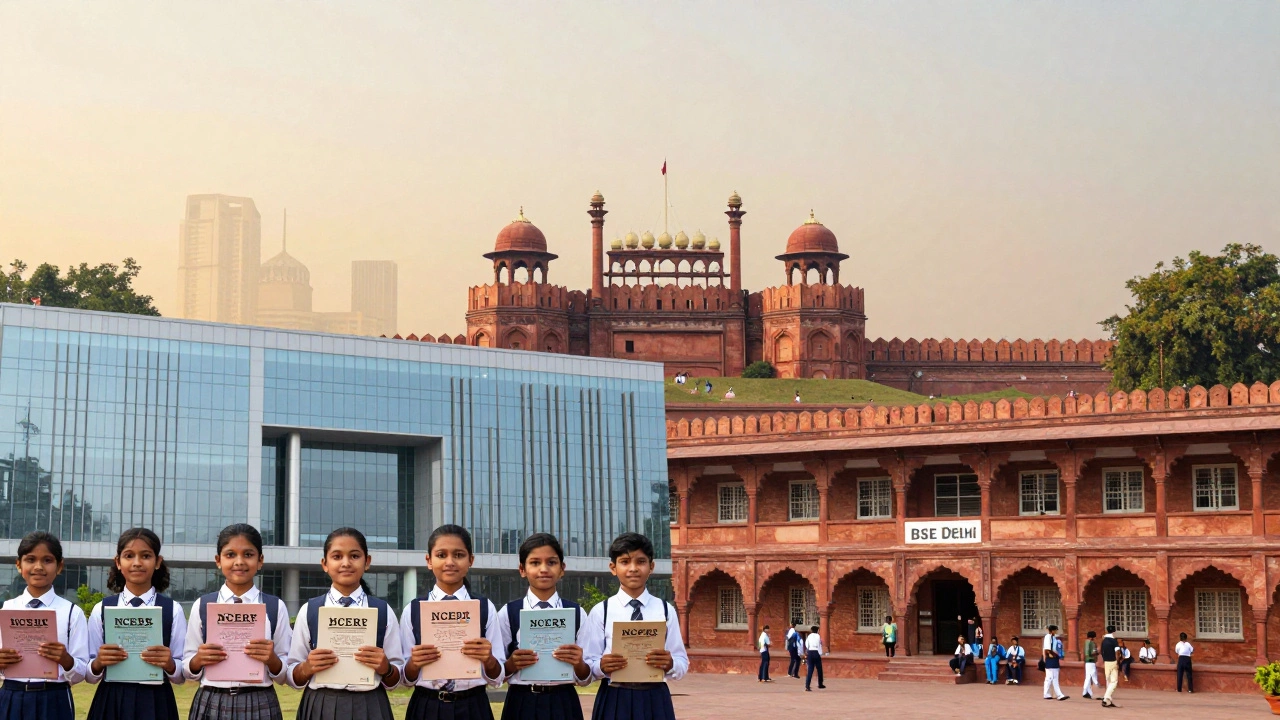
Is CBSE a Delhi Board? Clearing Up the Confusion
You might have heard someone say, "I studied in the Delhi board," and assumed they meant the Central Board of Secondary Education. It’s a common mix-up, especially for parents new to the Indian education system or students looking at schools outside their home state. But here is the short answer: CBSE is not the Delhi board. They are two separate entities that operate under different rules, even though they share the same capital city.
To understand why this confusion exists—and why it matters for your child’s schooling or your own career path—we need to look at how India structures its secondary education. The landscape isn’t just one big national system; it’s a patchwork of central boards, state boards, and private affiliations. Knowing the difference between them can save you from applying to the wrong exams or misunderstanding curriculum standards.
The Real Identity of CBSE
Central Board of Secondary Education (CBSE) is a national-level board of education for public and private schools, located in New Delhi, India. Unlike a state board that serves only one region, CBSE operates across the entire country. It also has an international presence, with affiliated schools in over 30 countries, including Nepal, UAE, Qatar, and Oman.
Think of CBSE as a franchise model. The board sets the standards, the syllabus, and the exam patterns. Individual schools then apply to get "affiliated" with CBSE. Once approved, these schools must follow the CBSE curriculum. This includes using textbooks published by NCERT (National Council of Educational Research and Training), which is the government body responsible for designing the curriculum.
Because CBSE is centralized, a student in Mumbai taking a Class 10 math exam sits for the same test, on the same day, with the same marking scheme as a student in Kolkata. This uniformity is why CBSE is popular among families who move frequently—like children of military personnel, railway employees, or corporate workers. If you switch cities, your academic record transfers smoothly because the board remains the same.
What Is the Delhi Board?
If CBSE is the national player, the "Delhi board" refers to the Board of School Education, Delhi (BSE Delhi). This is a state board. It was established in 1994 when Delhi became a Union Territory with its own legislative assembly. Before that, schools in Delhi were mostly affiliated with CBSE or other central boards.
BSE Delhi manages government-run schools and some private schools within the National Capital Region. Its primary goal is to provide accessible education to local residents. The syllabus for BSE Delhi is often based on NCERT guidelines, but the board has the autonomy to tweak certain subjects, add regional languages like Hindi or Urdu more prominently, and set its own exam schedules.
Here is the key distinction: A school can be physically located in Delhi but still be part of CBSE. In fact, most prestigious private schools in Delhi are CBSE-affiliated. Conversely, a school can be part of BSE Delhi but located just outside the city limits if it falls under the administrative jurisdiction of the Delhi education department. Location does not dictate the board; affiliation does.
Why Do People Mix Them Up?
The confusion stems from three main factors: geography, language, and overlap.
- Geographic Proximity: Both boards have their headquarters in New Delhi. When people hear "board in Delhi," they assume there is only one.
- Curriculum Similarity: Both CBSE and BSE Delhi use NCERT books for core subjects like Math, Science, and Social Studies. To a parent checking homework, the content looks identical.
- Colloquial Usage: In everyday conversation, many Delhi residents refer to any school exam as the "Delhi board exam." This casual language blurs the technical lines.
However, for official purposes—like college admissions or job applications—the distinction is critical. A mark sheet from CBSE will clearly state "Central Board of Secondary Education." A mark sheet from the state board will say "Board of School Education, Delhi." Universities treat them differently during cut-off calculations.
Key Differences: CBSE vs. Delhi Board
| Feature | CBSE | Delhi Board (BSE Delhi) |
|---|---|---|
| Jurisdiction | National (India) & International | State (Delhi NCR only) |
| Affiliation Type | Private & Government Schools | Primarily Government & Local Private |
| Syllabus Source | Strictly NCERT | NCERT-based with State modifications |
| Exam Conduct | Centralized nationwide exams | Local exams managed by Delhi authorities |
| Language Options | English, Hindi, Sanskrit, Foreign Languages | Hindi, English, Urdu, Punjabi, etc. |
| Recognition | Highly recognized for competitive exams (JEE, NEET) | Recognized locally; may require equivalence for some top colleges |
Which One Should You Choose?
Your choice depends on your long-term goals. If you plan to take competitive entrance exams like JEE (engineering) or NEET (medical), CBSE is generally considered safer. The syllabus alignment with NCERT is exact, and the exam pattern mirrors the difficulty level of these national tests. Many coaching institutes design their materials around the CBSE framework.
On the other hand, if you are looking for affordable education within Delhi and plan to attend state universities like Delhi University (DU) or GGSIPU, the Delhi Board is perfectly adequate. These universities accept BSE Delhi marksheets without issue. In fact, for DU admissions, the merit list is calculated based on Class 12 board scores regardless of whether you are from CBSE or the state board, provided you meet the subject requirements.
For students aiming for higher studies abroad, CBSE often carries slightly more weight due to its international recognition. Admissions officers in the UK, US, or Canada are familiar with the CBSE grading system. While they will evaluate BSE Delhi results too, you might need to provide additional context or equivalency certificates.
Common Misconceptions About Affiliation
One major myth is that "private" means "better" or "different." In reality, both CBSE and BSE Delhi have private schools. However, CBSE has a much larger network of private institutions. If you see a school advertising "ICSE" or "IB," those are completely different boards again. ICSE (Indian Certificate of Secondary Education) is known for its detailed English literature focus, while IB (International Baccalaureate) is a global program with a very different assessment style.
Another misconception is that state boards are easier. While some argue that state boards have simpler exams, the truth is that the quality of education depends on the specific school, not just the board. A well-run BSE Delhi school can produce better results than a poorly managed CBSE school. Always visit the campus, check teacher-student ratios, and talk to current parents before deciding.
Impact on College Admissions
In India, the Common Seat Admission Process (CSAP) for Delhi University accepts candidates from all recognized boards. There is no bias against BSE Delhi students. However, for IITs and NITs, the entry is through JEE Main and Advanced, not board marks. So, the board itself doesn’t block your path to engineering. What matters is your performance in the entrance exam.
For professional courses like CA (Chartered Accountancy) or CS (Company Secretary), exemptions are granted based on board percentages. CBSE students often find it easier to claim exemptions because the syllabus matches closely with the foundation courses offered by these institutes. BSE Delhi students may need to take additional bridge courses if their syllabus diverged significantly.
Final Thoughts on Choosing a Path
So, is CBSE a Delhi board? No. It is a central board that happens to have its office in Delhi. The Delhi Board is a separate state entity. Understanding this helps you navigate school admissions, exam preparations, and college applications with clarity.
If stability and national mobility are your priorities, go for CBSE. If you value local accessibility and cost-effectiveness within Delhi, the state board is a solid option. Neither is inherently superior; they serve different needs. The best board is the one that aligns with your child’s learning style and your family’s future plans.
Is CBSE only for Delhi students?
No, CBSE is not limited to Delhi. It is a national board with schools across all states in India and in many foreign countries. Any school, regardless of location, can apply for CBSE affiliation if it meets the infrastructure and faculty requirements.
Can I switch from CBSE to Delhi Board in Class 11?
Yes, you can switch, but it requires careful planning. You must ensure that the subjects you choose in the new board match your previous studies. Some topics may differ, so you might need to self-study to catch up. Also, check if the new school has seats available and accepts lateral entrants.
Are CBSE exams harder than Delhi Board exams?
Generally, CBSE exams are perceived as slightly more rigorous because they prepare students for national competitive tests. However, the difficulty level varies by subject and year. BSE Delhi exams tend to be more descriptive and focused on local context, while CBSE emphasizes conceptual understanding and application.
Does Delhi University prefer CBSE students?
No, Delhi University does not prefer CBSE students. Admissions are based on merit marks obtained in Class 12 from any recognized board. The university uses a standard formula to calculate cutoffs, ensuring fairness across CBSE, ICSE, State Boards, and others.
What is the role of NCERT in both boards?
NCERT provides the textbook content and curriculum framework. CBSE strictly follows NCERT guidelines for its syllabus and exams. BSE Delhi also uses NCERT books but may modify certain chapters or add state-specific content, especially in social studies and languages.
You might have heard someone say, "I studied in the Delhi board," and assumed they meant the Central Board of Secondary Education. It’s a common mix-up, especially for parents new to the Indian education system or students looking at schools outside their home state. But here is the short answer: CBSE is not the Delhi board. They are two separate entities that operate under different rules, even though they share the same capital city.
To understand why this confusion exists-and why it matters for your child’s schooling or your own career path-we need to look at how India structures its secondary education. The landscape isn’t just one big national system; it’s a patchwork of central boards, state boards, and private affiliations. Knowing the difference between them can save you from applying to the wrong exams or misunderstanding curriculum standards.
The Real Identity of CBSE
Central Board of Secondary Education (CBSE) is a national-level board of education for public and private schools, located in New Delhi, India. Unlike a state board that serves only one region, CBSE operates across the entire country. It also has an international presence, with affiliated schools in over 30 countries, including Nepal, UAE, Qatar, and Oman.
Think of CBSE as a franchise model. The board sets the standards, the syllabus, and the exam patterns. Individual schools then apply to get "affiliated" with CBSE. Once approved, these schools must follow the CBSE curriculum. This includes using textbooks published by NCERT (National Council of Educational Research and Training), which is the government body responsible for designing the curriculum.
Because CBSE is centralized, a student in Mumbai taking a Class 10 math exam sits for the same test, on the same day, with the same marking scheme as a student in Kolkata. This uniformity is why CBSE is popular among families who move frequently-like children of military personnel, railway employees, or corporate workers. If you switch cities, your academic record transfers smoothly because the board remains the same.
What Is the Delhi Board?
If CBSE is the national player, the "Delhi board" refers to the Board of School Education, Delhi (BSE Delhi). This is a state board. It was established in 1994 when Delhi became a Union Territory with its own legislative assembly. Before that, schools in Delhi were mostly affiliated with CBSE or other central boards.
BSE Delhi manages government-run schools and some private schools within the National Capital Region. Its primary goal is to provide accessible education to local residents. The syllabus for BSE Delhi is often based on NCERT guidelines, but the board has the autonomy to tweak certain subjects, add regional languages like Hindi or Urdu more prominently, and set its own exam schedules.
Here is the key distinction: A school can be physically located in Delhi but still be part of CBSE. In fact, most prestigious private schools in Delhi are CBSE-affiliated. Conversely, a school can be part of BSE Delhi but located just outside the city limits if it falls under the administrative jurisdiction of the Delhi education department. Location does not dictate the board; affiliation does.
Why Do People Mix Them Up?
The confusion stems from three main factors: geography, language, and overlap.
- Geographic Proximity: Both boards have their headquarters in New Delhi. When people hear "board in Delhi," they assume there is only one.
- Curriculum Similarity: Both CBSE and BSE Delhi use NCERT books for core subjects like Math, Science, and Social Studies. To a parent checking homework, the content looks identical.
- Colloquial Usage: In everyday conversation, many Delhi residents refer to any school exam as the "Delhi board exam." This casual language blurs the technical lines.
However, for official purposes-like college admissions or job applications-the distinction is critical. A mark sheet from CBSE will clearly state "Central Board of Secondary Education." A mark sheet from the state board will say "Board of School Education, Delhi." Universities treat them differently during cut-off calculations.

Key Differences: CBSE vs. Delhi Board
| Feature | CBSE | Delhi Board (BSE Delhi) |
|---|---|---|
| Jurisdiction | National (India) & International | State (Delhi NCR only) |
| Affiliation Type | Private & Government Schools | Primarily Government & Local Private |
| Syllabus Source | Strictly NCERT | NCERT-based with State modifications |
| Exam Conduct | Centralized nationwide exams | Local exams managed by Delhi authorities |
| Language Options | English, Hindi, Sanskrit, Foreign Languages | Hindi, English, Urdu, Punjabi, etc. |
| Recognition | Highly recognized for competitive exams (JEE, NEET) | Recognized locally; may require equivalence for some top colleges |
Which One Should You Choose?
Your choice depends on your long-term goals. If you plan to take competitive entrance exams like JEE (engineering) or NEET (medical), CBSE is generally considered safer. The syllabus alignment with NCERT is exact, and the exam pattern mirrors the difficulty level of these national tests. Many coaching institutes design their materials around the CBSE framework.
On the other hand, if you are looking for affordable education within Delhi and plan to attend state universities like Delhi University (DU) or GGSIPU, the Delhi Board is perfectly adequate. These universities accept BSE Delhi marksheets without issue. In fact, for DU admissions, the merit list is calculated based on Class 12 board scores regardless of whether you are from CBSE or the state board, provided you meet the subject requirements.
For students aiming for higher studies abroad, CBSE often carries slightly more weight due to its international recognition. Admissions officers in the UK, US, or Canada are familiar with the CBSE grading system. While they will evaluate BSE Delhi results too, you might need to provide additional context or equivalency certificates.
Common Misconceptions About Affiliation
One major myth is that "private" means "better" or "different." In reality, both CBSE and BSE Delhi have private schools. However, CBSE has a much larger network of private institutions. If you see a school advertising "ICSE" or "IB," those are completely different boards again. ICSE (Indian Certificate of Secondary Education) is known for its detailed English literature focus, while IB (International Baccalaureate) is a global program with a very different assessment style.
Another misconception is that state boards are easier. While some argue that state boards have simpler exams, the truth is that the quality of education depends on the specific school, not just the board. A well-run BSE Delhi school can produce better results than a poorly managed CBSE school. Always visit the campus, check teacher-student ratios, and talk to current parents before deciding.
Impact on College Admissions
In India, the Common Seat Admission Process (CSAP) for Delhi University accepts candidates from all recognized boards. There is no bias against BSE Delhi students. However, for IITs and NITs, the entry is through JEE Main and Advanced, not board marks. So, the board itself doesn’t block your path to engineering. What matters is your performance in the entrance exam.
For professional courses like CA (Chartered Accountancy) or CS (Company Secretary), exemptions are granted based on board percentages. CBSE students often find it easier to claim exemptions because the syllabus matches closely with the foundation courses offered by these institutes. BSE Delhi students may need to take additional bridge courses if their syllabus diverged significantly.
Final Thoughts on Choosing a Path
So, is CBSE a Delhi board? No. It is a central board that happens to have its office in Delhi. The Delhi Board is a separate state entity. Understanding this helps you navigate school admissions, exam preparations, and college applications with clarity.
If stability and national mobility are your priorities, go for CBSE. If you value local accessibility and cost-effectiveness within Delhi, the state board is a solid option. Neither is inherently superior; they serve different needs. The best board is the one that aligns with your child’s learning style and your family’s future plans.
Is CBSE only for Delhi students?
No, CBSE is not limited to Delhi. It is a national board with schools across all states in India and in many foreign countries. Any school, regardless of location, can apply for CBSE affiliation if it meets the infrastructure and faculty requirements.
Can I switch from CBSE to Delhi Board in Class 11?
Yes, you can switch, but it requires careful planning. You must ensure that the subjects you choose in the new board match your previous studies. Some topics may differ, so you might need to self-study to catch up. Also, check if the new school has seats available and accepts lateral entrants.
Are CBSE exams harder than Delhi Board exams?
Generally, CBSE exams are perceived as slightly more rigorous because they prepare students for national competitive tests. However, the difficulty level varies by subject and year. BSE Delhi exams tend to be more descriptive and focused on local context, while CBSE emphasizes conceptual understanding and application.
Does Delhi University prefer CBSE students?
No, Delhi University does not prefer CBSE students. Admissions are based on merit marks obtained in Class 12 from any recognized board. The university uses a standard formula to calculate cutoffs, ensuring fairness across CBSE, ICSE, State Boards, and others.
What is the role of NCERT in both boards?
NCERT provides the textbook content and curriculum framework. CBSE strictly follows NCERT guidelines for its syllabus and exams. BSE Delhi also uses NCERT books but may modify certain chapters or add state-specific content, especially in social studies and languages.