
School Board Suitability Calculator
Select the options that best describe your situation and your child's needs to find the most suitable curriculum.
Recommended:
Why this fits:
Alternative Option:
Picking the right school curriculum feels like a high-stakes gamble. You want your child to be happy, but you also want them to be ready for competitive exams or university abroad. The confusion usually boils down to three main options in India: CBSE is the Central Board of Secondary Education, known for its standardized national curriculum and focus on science and mathematics., ICSE is the Indian Certificate of Secondary Education, recognized for its detailed approach to English language and holistic learning., and the various State Boards.
There is no single "best" syllabus that works for every child. The right choice depends entirely on where you see your child’s future-whether it’s engineering in India, arts abroad, or a career in business. Let’s break down what each board actually offers so you can make a decision based on facts, not just neighborhood pressure.
Understanding the Core Differences
Before diving into pros and cons, you need to understand the philosophy behind each board. They are not just different lists of topics; they represent different ways of teaching.
CBSE follows a centralized structure. It aligns closely with the National Curriculum Framework (NCF) and focuses heavily on conceptual clarity in Science and Math. The exams are strictly objective, which means there is little room for interpretation. If the answer key says A, then A is correct. This creates a uniform standard across the country, making it easier to transfer schools if your family moves.
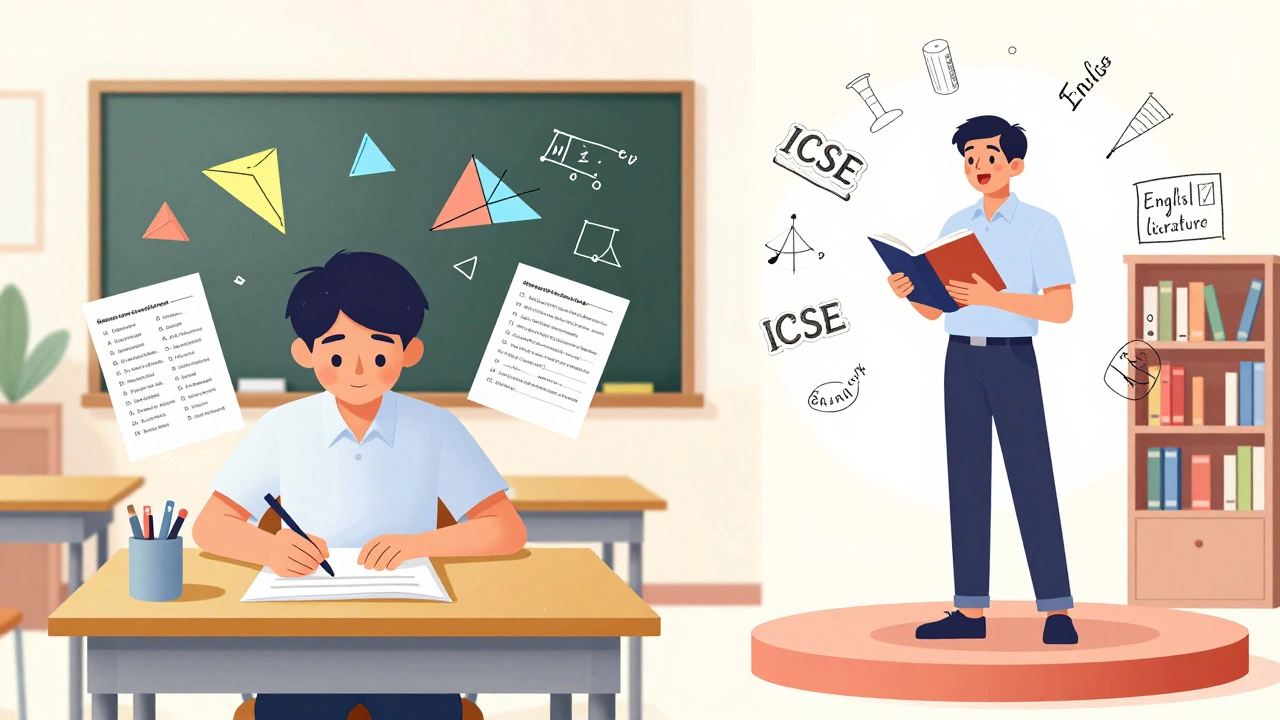
In contrast, ICSE, administered by the Council for the Indian School Certificate Examinations (CISCE), emphasizes depth over breadth. The syllabus is vast, particularly in English literature and languages. Students often read entire novels rather than excerpts. The evaluation method includes internal assessments and projects, meaning your final grade isn’t just about one stressful exam day.
State Boards vary significantly from region to region. Some, like Maharashtra or Karnataka boards, have robust curricula that rival central boards. Others may lag in infrastructure or updated content. However, they often teach in the local medium of instruction, which can help children retain their cultural roots and language skills better.
| Feature | CBSE | ICSE | State Board |
|---|---|---|---|
| Focus Area | Science & Math | English & Languages | Varies by Region |
| Exam Pattern | Objective/Multiple Choice | Descriptive/Subjective | Mixed |
| Syllabus Depth | Moderate | Very Detailed | Inconsistent |
| Best For | Engineering/Medical Aspirants | Arts/Literature/Abroad Studies | Local University Entrances |
| Transferability | High (Nationwide) | Medium (Private Schools) | Low (Region Specific) |
Why Parents Often Choose CBSE
If you live in a metropolitan city like Delhi, Mumbai, or Bangalore, you will notice that CBSE dominates the landscape. Why? Because it is the most pragmatic choice for competitive entrance exams.
The JEE Main is the Joint Entrance Examination, the primary gateway for undergraduate engineering courses in India's top institutes. and NEET is the National Eligibility cum Entrance Test, required for admission to medical colleges in India. follow a pattern that mirrors CBSE textbooks closely. When a student studies from NCERT books (published by the National Council of Educational Research and Training), they are essentially studying the core material needed for these exams.
This alignment reduces the cognitive load during Class 11 and 12. Students don’t have to learn two different sets of formulas-one for school and another for JEE. It simplifies life. Additionally, CBSE schools are everywhere. From military stations to industrial towns, if your job requires relocation, finding a CBSE-affiliated school is rarely an issue. This continuity prevents academic gaps when moving.
However, this comes at a cost. The rigid structure can feel suffocating for creative minds. There is less emphasis on critical thinking essays or open-ended projects compared to other boards. It is a system designed for efficiency and standardization, not necessarily for nurturing unique artistic talents.
The Case for ICSE: Building Strong Foundations
ICSE has a reputation for being tougher, especially in English. And honestly, it is. By the time an ICSE student finishes Class 10, they often have a vocabulary and grammatical precision that their CBSE peers might lack. This is because the board mandates extensive reading and writing practice.
If you plan to send your child to university in the UK, US, or Canada, this foundation helps immensely. Universities abroad value strong communication skills. An ICSE graduate can write a coherent essay under pressure, which is a skill highly prized in liberal arts programs.
Moreover, ICSE encourages co-curricular activities. Music, drama, and sports are integrated more naturally into the assessment process. It’s not just about marks; it’s about building a well-rounded individual. The board allows for more creativity in answers. If a student explains a concept correctly but uses a different method, they still get credit. This fosters confidence and independent thinking.
The downside? The syllabus is massive. Students spend hours memorizing dates, names, and literary quotes. It can lead to burnout if not managed well. Also, transitioning from ICSE to CBSE-based coaching for JEE/NEET later on can be jarring because the depth of detail differs.
State Boards: The Local Advantage
Don’t dismiss State Boards too quickly. In states like Tamil Nadu, Kerala, or West Bengal, the state boards have excellent reputations. They often incorporate local history, culture, and languages into the curriculum, which keeps students connected to their identity.
For families who do not plan to move out of the state, a State Board education is perfectly sufficient. Many state universities accept state board certificates directly without additional bridge courses. Plus, tuition fees for state-run schools are often lower than private CBSE or ICSE institutions.
However, the quality control varies. One district might have world-class teachers, while the next struggles with basic resources. If you choose a State Board, visit the specific school thoroughly. Don’t assume all state schools are equal. Check their past results, teacher qualifications, and infrastructure personally.
Emerging Alternatives: IB and IGCSE
We cannot talk about syllabi in 2026 without mentioning international boards. IB is the International Baccalaureate program, a globally recognized curriculum focused on inquiry-based learning and international-mindedness. and IGCSE is the International General Certificate of Secondary Education, offered by Cambridge Assessment, popular among expatriates and elite private schools. are gaining traction in major cities.
These boards are expensive. Tuition fees can be triple that of average CBSE schools. But they offer a completely different educational experience. IB focuses on research, theory of knowledge, and community service. It prepares students for global citizenship. If your budget allows and you aim for Ivy League or Oxbridge universities, IB is arguably the best preparation available.
IGCSE is slightly more traditional but still flexible. It allows students to choose subjects based on interest rather than following a fixed stream. This autonomy helps teenagers discover their passions early. However, these boards are not ideal if you intend to take Indian competitive exams like JEE, as the syllabus overlap is minimal.
How to Decide: A Practical Checklist
To make the final call, ask yourself these questions:
- Where will they study higher education? If it’s IITs or AIIMS, lean towards CBSE. If it’s abroad, consider ICSE or IB.
- What is your child’s learning style? Do they thrive on structure and clear rules (CBSE)? Or do they prefer discussion and exploration (ICSE/IB)?
- How stable is your location? Frequent movers should stick to CBSE or IB for seamless transitions.
- What is your budget? International boards require significant financial investment. State boards are the most economical.
- Do you value language proficiency? If English fluency is a priority, ICSE provides rigorous training.
Remember, the syllabus is just the framework. The real magic happens in the classroom. A passionate teacher in a State Board school can inspire more than a disengaged one in a premium CBSE institute. Visit the schools. Talk to current parents. Observe how students interact. The environment matters just as much as the curriculum.
Common Misconceptions About School Boards
Let’s clear up some myths that cloud judgment. First, the idea that CBSE students are "robotic" is outdated. Modern CBSE schools integrate project work and practicals extensively. Second, the belief that ICSE is only for "artsy" kids is wrong. Many ICSE students excel in STEM fields because the foundational logic is strong.
Another myth is that State Boards are inferior. While true in some regions, top-performing state boards produce scholars who compete nationally. The gap is narrowing due to digital learning resources. Today, a student in a remote village can access the same video lectures as someone in Mumbai. The syllabus matters less than the access to quality supplementary materials.
Finally, don’t let peer pressure dictate your choice. Just because your neighbor’s kid is in an IB school doesn’t mean it’s right for yours. Every child is unique. What worked for one sibling might fail for another. Trust your instincts and your child’s needs.
Is CBSE better than ICSE for engineering?
Yes, generally speaking. CBSE syllabus aligns more closely with the JEE Main and Advanced patterns. The NCERT textbooks are considered the bible for engineering entrance prep. However, many ICSE students also crack JEE by joining coaching classes that bridge the syllabus gap.
Can I switch from CBSE to ICSE in middle school?
It is possible but challenging. You will need to adapt to a more descriptive exam style and a heavier workload in languages. Most private schools allow lateral entry, but check their specific policies regarding age limits and subject prerequisites.
Which board is best for studying abroad?
IB and IGCSE are preferred by Western universities due to their recognition and pedagogical similarity. However, CBSE and ICSE are widely accepted. Top universities look at extracurriculars, essays, and test scores (SAT/ACT) rather than just the school board.
Are State Board certificates valid for government jobs?
Absolutely. All recognized state boards are approved by the UGC and relevant government bodies. Their certificates hold equal validity for SSC, UPSC, and other civil services examinations.
Does the syllabus affect my child's mental health?
Indirectly, yes. High-pressure environments, regardless of the board, can cause stress. CBSE’s competitive nature might stress some, while ICSE’s volume of work might overwhelm others. Look for schools that prioritize holistic development and provide counseling support.