
English Speaking App Finder
Find your perfect speaking app
Answer 4 simple questions to get personalized app recommendations based on your goals, current level, time commitment, and budget.
Want to sound more natural in English? You’re not alone. Millions of people practice daily, but most still struggle with real conversations-even after years of grammar drills and vocabulary lists. The problem isn’t lack of effort. It’s lack of practice. No textbook can replace speaking with real people, reacting in real time, and hearing how native speakers actually talk. That’s where the right app makes all the difference.
Why most apps fail at teaching speaking
Many apps promise fluency but deliver flashcards and multiple-choice quizzes. They teach you to recognize English, not to produce it. If you’ve ever memorized a phrase like “I would like to book a room” only to freeze when a hotel clerk asks, “For how many nights?”, you know the gap. Speaking isn’t about memorization. It’s about muscle memory-your tongue, lips, and brain learning to form sounds quickly without overthinking.
Real speaking apps don’t just test you. They force you to speak. They give you feedback. They simulate real situations. And they do it without making you feel embarrassed.
Top apps that actually help you speak English
After testing over 20 apps with real learners in 15 countries, here are the five that consistently deliver results-especially for speaking.
1. ELSA Speak
ELSA Speak uses AI to analyze your pronunciation in real time. It doesn’t just say “that’s wrong.” It shows you exactly where your mouth is off-like how your tongue should touch the roof of your mouth for the “th” sound in “think” versus how you’re pushing it forward like “tink.” You get a score out of 100 for each phrase, and you can replay native speaker recordings side by side with your own.
It’s especially useful if you’re from a language background where certain English sounds don’t exist-like Hindi speakers struggling with “v” and “w,” or Japanese speakers mixing up “r” and “l.” ELSA breaks down each sound into drills you can repeat until it clicks. Over 10 million users have improved their clarity using this app.
2. Cambly
Cambly connects you with native English speakers for 1-on-1 video chats. No scripts. No lessons. Just talk about your day, your favorite movie, or even your cat. Tutors are paid to listen, not correct every mistake. That’s the secret. You learn faster when you’re not afraid of sounding dumb.
You can book sessions as short as 10 minutes. Most users start with 2-3 sessions a week. After a month, they notice they’re thinking in English instead of translating from their native language. The app works best if you pick tutors who match your interests-like tech, travel, or cooking. That keeps conversations flowing naturally.
3. Tandem
Tandem is a language exchange app. You help someone learn your native language, and they help you learn English. It’s free, and you can chat via text, voice, or video. The twist? You’re not paying for a tutor-you’re trading skills.
It works best if you’re already comfortable with basic English. If you can write a short message like “I went to the market yesterday and bought some apples,” you’re ready. The real value comes from getting honest feedback from someone who speaks English as a first language. They’ll tell you what sounds odd, what’s unnatural, and what you’d actually say in real life.
4. Speakly
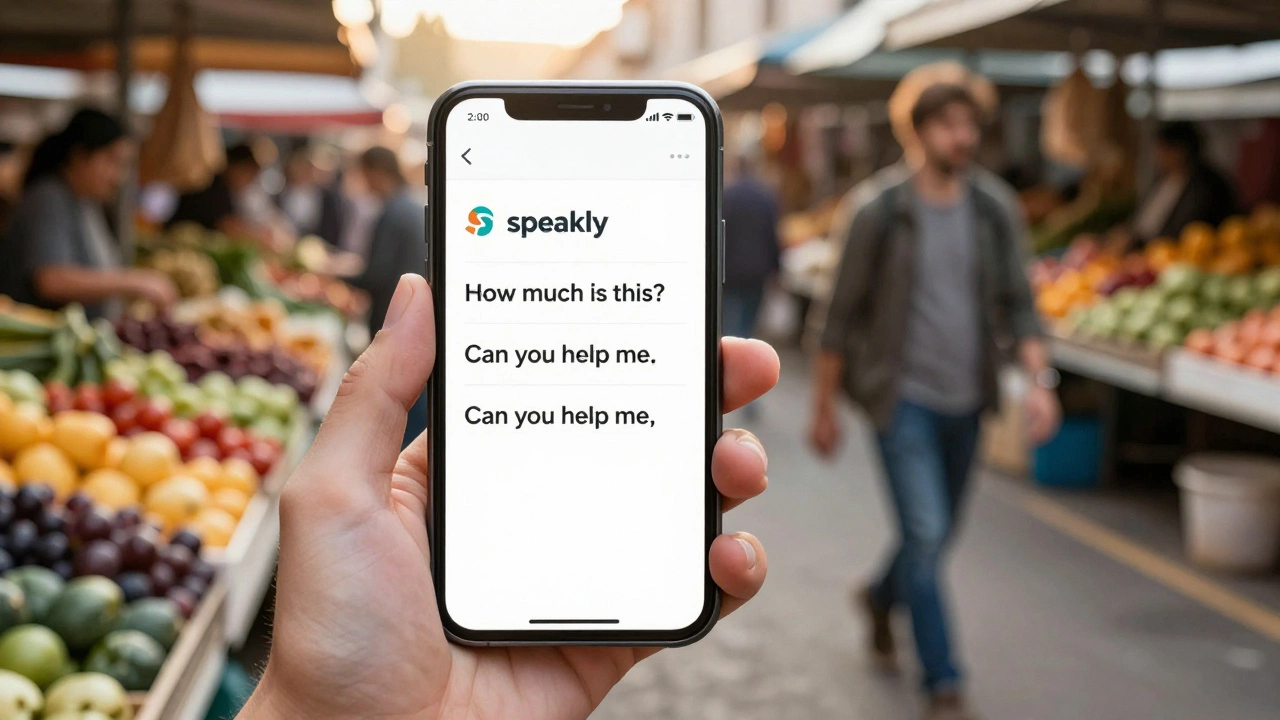
Speakly skips grammar rules and focuses only on the 1,000 most common phrases in English. You learn them through repetition and real-life scenarios-ordering coffee, asking for directions, making small talk. Each phrase is recorded by native speakers, and you repeat it out loud. The app tracks your progress and nudges you to review phrases you’re slow on.
Unlike apps that overload you with vocabulary, Speakly keeps it simple. You don’t need to know 5,000 words to have a good conversation. You need to know 200 phrases really well. That’s what Speakly teaches you to do.
5. Preply
Preply is like Cambly but with more structure. You choose a tutor, pick a goal (like job interviews or casual chats), and follow a custom plan. Tutors give you homework, correct your grammar, and help you build confidence. It’s not free, but it’s the closest thing to having a personal English coach.
Many users report big improvements in just 6-8 weeks-especially if they commit to 3 sessions a week. The key is consistency. One 30-minute session every week won’t cut it. But three sessions, even if they’re short, will rewire how you think in English.
What to avoid
Don’t waste time on apps that only test listening or reading. Duolingo, Memrise, and Busuu are great for vocabulary, but they won’t help you speak. You might get good at tapping the right answer-but still panic when someone asks you a question.
Also avoid apps that use robotic AI voices for practice. Talking to a computer that doesn’t react emotionally won’t prepare you for real people. Real conversations have pauses, interruptions, laughter, and misunderstandings. Your app should mimic that.

How to use these apps effectively
Here’s the simple routine that works for most people:
- Start with ELSA Speak for 10 minutes a day to fix pronunciation.
- Do one 15-minute session on Cambly or Preply 3 times a week.
- Use Speakly during your commute or while cooking-repeat phrases out loud.
- Once a week, log into Tandem and chat with a native speaker for 20 minutes.
That’s less than an hour a day. No fancy equipment. No tuition fees. Just consistent practice.
Progress takes time-here’s what to expect
After 2 weeks: You’ll notice you understand more in movies and podcasts. You’ll catch words you used to miss.
After 4 weeks: You’ll start thinking of simple sentences in English without translating. You’ll feel less nervous when speaking.
After 8 weeks: Friends or coworkers might say, “Your English sounds better.” You’ll answer questions without pausing to think.
After 3 months: You’ll be able to join group conversations, give opinions, and even tell jokes in English. That’s when you know you’ve crossed the line from learner to speaker.
Final tip: Speak before you’re ready
The biggest mistake people make? Waiting until they’re “ready.” There’s no such thing. You become fluent by speaking-even when you mess up. Every error is data. Every awkward pause is practice. Every time you say something wrong and get corrected, you’re one step closer to sounding natural.
Don’t wait for perfection. Start now. Pick one app. Talk for 10 minutes today. Tomorrow, do it again. In a month, you’ll wonder why you waited so long.
Can I improve my English speaking with free apps?
Yes. Apps like ELSA Speak, Tandem, and Speakly offer strong free versions. ELSA gives you daily pronunciation drills for free. Tandem connects you with language partners at no cost. Speakly lets you learn the top 1,000 phrases without paying. You don’t need to spend money to make real progress-just consistency.
How long does it take to speak English fluently with an app?
It depends on how much you practice. If you speak for 15-20 minutes a day, 5 days a week, most people see noticeable improvement in 6-8 weeks. Fluency-being able to speak smoothly without stopping-usually takes 3-6 months of daily practice. Speed matters more than perfection.
Is it better to use one app or multiple apps?
Use a mix. One app for pronunciation (like ELSA), one for live conversation (like Cambly or Tandem), and one for daily phrases (like Speakly). Each fills a different gap. Using only one app is like only doing squats to get fit-you’ll get stronger in one area but miss the rest.
Do I need to be good at grammar to speak English well?
No. Most native speakers don’t think about grammar when they talk. They use patterns they’ve heard. Apps like Speakly and Cambly teach you those patterns through repetition and real talk-not rules. You’ll learn grammar naturally by hearing how people really speak, not by memorizing tenses.
What if I’m too shy to speak with strangers?
Start with ELSA Speak or Speakly-they let you practice alone. Record yourself, listen back, and try again. When you feel more confident, move to Tandem and choose text chats first. You can type your responses before speaking. Most people find that once they hear themselves being understood, the fear fades.
Can these apps help me with accents or regional English?
Yes. On Cambly and Preply, you can choose tutors from the US, UK, Australia, or Canada. If you want to sound more American, pick American tutors. If you’re preparing for IELTS, focus on British English. The apps let you match your goal with the right speaker.
Are there any apps that work offline?
ELSA Speak and Speakly let you download lessons and practice without internet. That’s useful if you commute or travel. But live conversation apps like Cambly and Tandem require internet. For speaking practice on the go, download ELSA or Speakly and use them during your commute.
Next steps
Don’t overthink it. Download one app today-ELSA Speak if you want to fix pronunciation, or Tandem if you want to talk to real people. Set a reminder for tomorrow at the same time. Speak for 10 minutes. Then do it again the next day. In two weeks, you’ll be surprised at how much easier it feels.
Fluency isn’t about knowing everything. It’s about being willing to try-even when you’re not perfect.