IIT Admission Probability Estimator
Your Admission Outlook
Getting a seat at an Indian Institute of Technology (IIT) is often described as one of the toughest academic hurdles in India. But if you are asking which specific campus is the hardest to crack, the answer isn't just "IIT Bombay" or "IIT Delhi." It depends entirely on what you want to study. A student with a rank of 10 might struggle to get Computer Science at IIT Bombay, while that same rank guarantees a spot in almost any branch at IIT Guwahati.
To understand the real difficulty, we have to look past the brand names and examine the data: closing ranks for popular branches like Computer Science (CS), Electronics and Communication Engineering (ECE), and Electrical Engineering (EE). The gap between the top three institutes-the so-called "Old IITs"-and the rest is massive, but even within that elite group, the competition varies wildly depending on your category and gender.
The Big Three: Why IIT Bombay, Delhi, and Kanpur Stand Alone
When people talk about the "hardest" IITs, they are usually referring to the trio of IIT Bombay, located in Mumbai, known for its strong industry connections and highest cutoffs for CS, IIT Delhi, situated in the capital, offering urban advantages and competitive placements, and IIT Kanpur, renowned for its research output and rigorous academic culture. These three consistently hold the highest closing ranks for their most sought-after courses.
Let's look at the numbers. For General Category male students aiming for Computer Science and Engineering (CSE), the closing rank for IIT Bombay often hovers around 50-80. That means you need to be in the top 0.01% of all JEE Advanced candidates. IIT Delhi follows closely, with cutoffs typically ranging between 60 and 100. IIT Kanpur is slightly more forgiving but still extremely exclusive, with cutoffs rarely exceeding 150 for CSE.
Why are these three so hard? It’s not just prestige. It’s location and ecosystem. Mumbai and Delhi offer immediate access to internships, networking events, and corporate headquarters. IIT Kanpur, while in a smaller city, has built a reputation for producing top-tier researchers and entrepreneurs. If your goal is a high-paying job immediately after graduation, these campuses provide the best pipeline.
The Myth of "Easiest" vs. "Hardest": Location Bias
There is a common misconception that newer IITs are "easier" to get into. While it is true that you can get a seat at IIT Hyderabad or IIT Roorkee with a lower rank than IIT Bombay, the story changes when you look at specific branches. Getting into Civil Engineering at IIT Bombay might require a rank of 3,000, whereas getting into CSE at IIT Hyderabad might require a rank of 400.
So, is IIT Hyderabad harder to get into than IIT Bombay? No. But is it harder to get into *Computer Science* at IIT Hyderabad than *Civil Engineering* at IIT Bombay? Yes. This distinction is crucial for your preparation strategy. Many students aim for the "safest" IIT only to end up in a branch they dislike because they didn’t analyze the branch-wise cutoffs.
Location plays a huge role here. Institutes in metropolitan areas like Delhi, Mumbai, and Bangalore (IISc Bangalore is separate, but IIT Madras is nearby) attract more applicants due to lifestyle preferences and internship opportunities. Consequently, their cutoffs for popular branches remain higher compared to institutes in tier-2 cities like IIT Mandi or IIT Patna.
Branch Matters More Than Campus
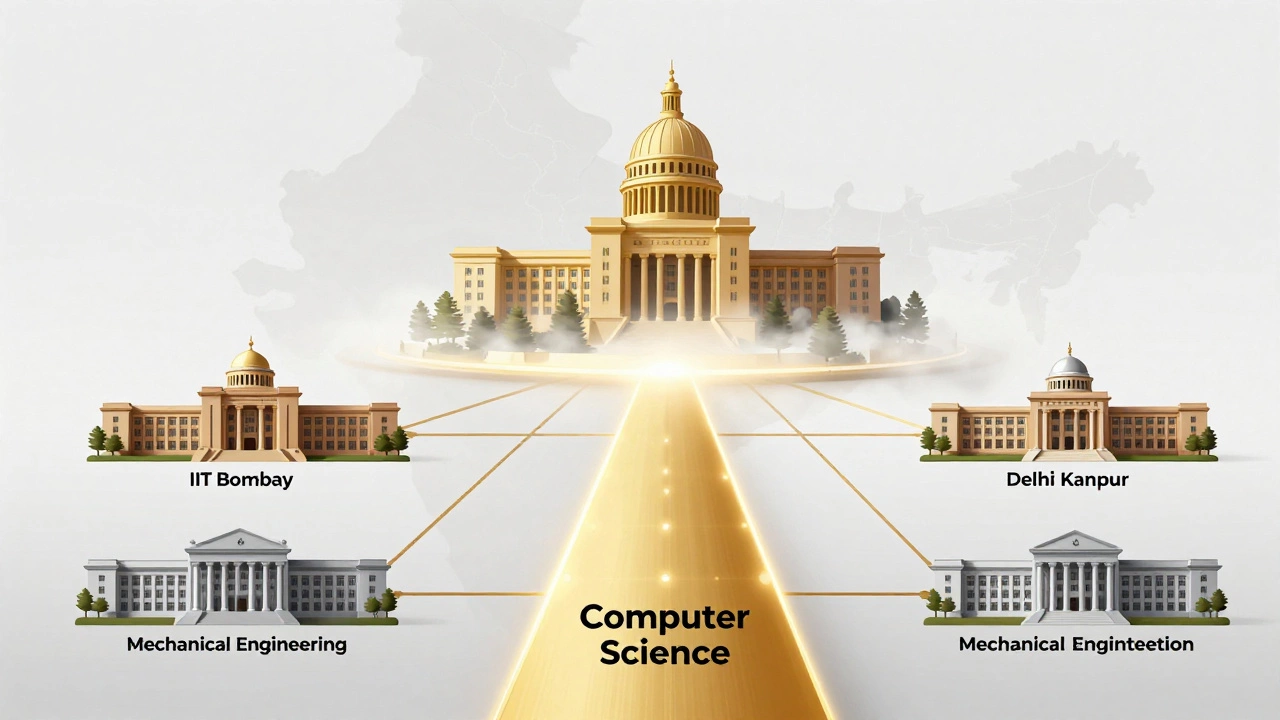
If you are serious about cracking an IIT, you must prioritize the branch over the institute name. Here is a breakdown of how difficulty shifts based on your major:
- Computer Science & Engineering (CSE): The undisputed king of cutoffs. Across all IITs, CSE has the highest demand. At IIT Bombay, the cutoff is near 50. At IIT Kharagpur, it might be 300. At IIT BHU, it could be 600. The relative difficulty remains consistent: CSE is always the hardest branch to secure.
- Electronics and Communication Engineering (ECE): The second most popular choice. Cutoffs are typically 1.5x to 2x higher than CSE. For example, if CSE closes at 100, ECE might close at 250.
- Electrical Engineering (EE): Slightly easier than ECE but still highly competitive. It offers good placement prospects in core engineering sectors.
- Mechanical Engineering: Often seen as a safe bet for general engineers, but top IITs still have strict cutoffs. It’s less volatile than CS/ECE.
- Civil/Agricultural/Mineral Engineering: These branches have significantly lower cutoffs. You can get into IIT Bombay with a rank of 2,000+ if you opt for Civil Engineering.
This hierarchy means that if you score a rank of 500, you won’t get CSE at IIT Bombay, but you might get Mechanical at IIT Delhi or CSE at IIT Indore. Your "hardest" IIT is the one where your desired branch closes just above your rank.

Category and Gender Quotas: Changing the Game
The difficulty of getting into an IIT is heavily influenced by your reservation category and gender. The Indian government mandates seats for Scheduled Castes (SC), Scheduled Tribes (ST), Other Backward Classes (OBC-NCL), and Economically Weaker Sections (EWS). Additionally, there are specific quotas for female candidates across all categories.
For a General Category male, the competition is fiercest. However, for a female candidate in the General Category, the effective cutoff is much lower. IITs reserve approximately 30% of seats for women. This means a rank of 1,500 might secure CSE at IIT Bombay for a girl, whereas a boy would need a rank under 100. Similarly, SC/ST/OBC candidates have separate merit lists with relaxed cutoffs. An OBC candidate might enter IIT Delhi with a rank of 1,000 in CSE, which is impossible for a General category student.
Understanding these quotas is essential. If you fall into a reserved category, your target list of "hardest" IITs expands significantly. You should analyze the previous year’s closing ranks specifically for your category, not the general aggregate.
| Institute | City | CSE Closing Rank | ECE Closing Rank | Difference Factor |
|---|---|---|---|---|
| IIT Bombay | Mumbai | ~50-80 | ~150-200 | High |
| IIT Delhi | New Delhi | ~60-100 | ~180-250 | High |
| IIT Kanpur | Kanpur | ~100-150 | ~250-350 | Medium-High |
| IIT Madras | Chennai | ~120-180 | ~300-400 | Medium-High |
| IIT Kharagpur | Kharagpur | ~250-350 | ~600-800 | Medium |
| IIT Roorkee | Roorkee | ~300-400 | ~700-900 | Medium |
Strategic Advice: How to Target the "Hardest" IITs
If your goal is to crack the most competitive seats, here is what you need to do differently from the average aspirant:
- Aim for a Rank Under 100: To guarantee a top branch at a top IIT, you need to be in the top 100 nationally. This requires near-perfect scores in both JEE Main and JEE Advanced.
- Master the Advanced Pattern: JEE Advanced is not just about speed; it’s about depth. Questions often combine multiple concepts. Practice multi-concept problems daily.
- Analyze Previous Year Trends: Look at the last 5 years of cutoffs. Some years, due to paper difficulty, ranks shift. Identify the trend, not just a single year’s data.
- Consider Dual Degrees: IITs offer Integrated M.Tech programs. Sometimes, the cutoffs for these are slightly different, offering alternative entry points.
- Don’t Ignore Aptitude Tests: Some IITs conduct additional aptitude tests for certain programs. Stay updated on official notifications.
Remember, the "hardest" IIT is subjective. For some, it’s IIT Bombay because of the dream. For others, it’s IIT Madras because of the tech ecosystem. Define your own metric of success-whether it’s research, startups, or corporate jobs-and choose the institute that aligns best with those goals.
Is IIT Bombay really the hardest to get into?
Yes, for Computer Science and related fields, IIT Bombay typically has the lowest closing ranks (highest difficulty) among all IITs. However, for less popular branches like Civil or Metallurgy, the cutoffs are significantly higher, making it easier to get in compared to other IITs' top branches.
What rank is needed for IIT Delhi CSE?
For General Category male students, a rank between 60 and 100 is typically required to secure a seat in Computer Science at IIT Delhi. Female candidates and reserved category students may have higher acceptable ranks due to quotas.
Are newer IITs easier to get into?
Generally, yes. Newer IITs like IIT Palakkad or IIT Dhanbad have higher closing ranks for similar branches compared to older IITs. However, their CSE branches are still competitive and require strong ranks, often under 1,000 for top spots.
Does gender affect IIT admission difficulty?
Yes, significantly. IITs reserve approximately 30% of seats for female candidates. This means the cutoff ranks for girls are much higher (easier to achieve) than for boys in the same category. A girl with a rank of 1,500 might get CSE at IIT Bombay, while a boy would need a rank under 100.
Which branch has the highest cutoff in all IITs?
Computer Science and Engineering (CSE) consistently has the highest cutoffs (lowest ranks) across all IITs. Electronics and Communication Engineering (ECE) follows closely behind. Core engineering branches like Mechanical or Civil have significantly lower cutoffs.