
Exam Difficulty Estimator
Select an exam from the list below to see a breakdown of its difficulty factors. The score is calculated based on statistical rarity (pass rate), temporal investment (prep time), and mental intensity (cognitive load).
Select an exam to view details.
Overall Difficulty Score (Max 100)
You might think you’ve had a tough week at work or school. But have you ever tried to solve an integral that stumped the brightest minds in Cambridge for decades? Or sat through nine hours of writing essays while thousands of others compete for three government seats? When we ask which exam is the hardest to pass, we aren’t just talking about difficult questions. We are talking about psychological endurance, statistical impossibility, and brutal selection processes.
The answer depends on who you ask and where they live. For a student in India, the UPSC Civil Services Examination is the Everest of tests. In China, it’s the Gaokao. In the United States, medical students dread the USMLE Step 1. Each of these exams has a different flavor of difficulty. Some test raw intelligence. Others test your ability to survive stress. Let’s break down the top contenders so you can see which one would actually break you.
Defining "Hard": It’s Not Just About IQ
Before we rank them, we need to agree on what makes an exam hard. It isn’t just about how complex the math is. If it were, every calculus final would be harder than the bar exam. Difficulty comes from three main factors:
- Pass Rate: How many people fail? If only 0.1% pass, it’s statistically brutal.
- Preparation Time: How long do you need to study? Three months? Five years?
- Cognitive Load: Does it require memorizing entire textbooks or solving novel problems under extreme time pressure?
A high school chemistry test might be cognitively hard, but if everyone passes, it’s not "hard" in the competitive sense. The exams below combine all three factors. They are designed to filter out the vast majority of candidates.
The UPSC Civil Services Examination (India)
If you want to become an IAS officer in India, you face the Union Public Service Commission (UPSC) exam. This is often cited as the toughest general competition in the world. Why? Because of the sheer volume of content and the low success rate.
Every year, over a million candidates apply. Only about 1,000 get selected. That’s a pass rate of roughly 0.1%. You don’t just take one test. You go through three stages: Preliminary (objective), Main (nine descriptive papers), and an Interview. The syllabus covers everything from history and geography to international relations and ethics. There is no fixed syllabus, meaning you could theoretically read every book in the library and still miss a question.
Most successful candidates spend two to four years preparing full-time. The mental toll is immense. You are competing against the best graduates in the country, many of whom have already failed once or twice. If you hate uncertainty and broad knowledge, this exam will crush you.
The Gaokao (China)
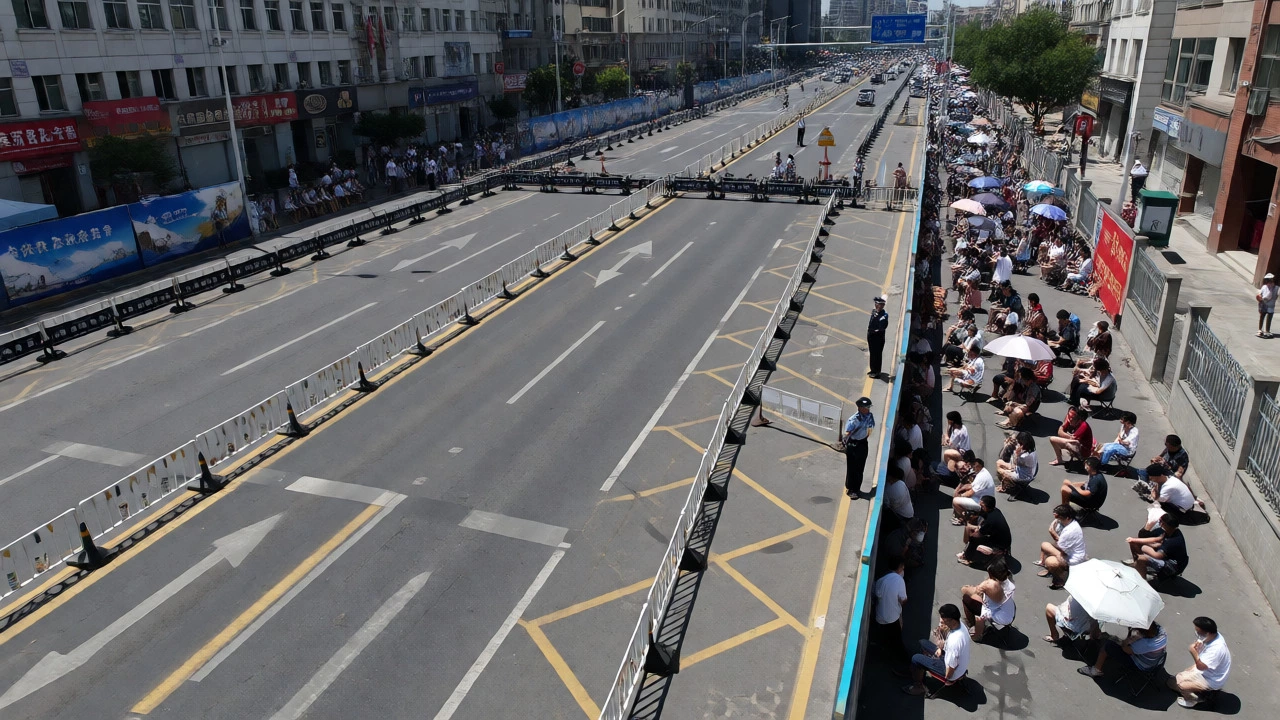
In China, the Gaokao is not just an exam; it’s a national event. Roads are closed near testing centers. Construction stops. Parents camp outside schools for days. This college entrance exam determines whether a student gets into a top university like Tsinghua or Peking University, which dictates their career path for life.
The Gaokao lasts for two to three days. It tests Chinese, Math, English, and either sciences or humanities. The difficulty lies in the competition. Millions of students take it simultaneously. To get into a prestigious university, you need a near-perfect score. One mistake in a multiple-choice question can drop your rank by thousands. The pressure starts in middle school. Students study 12-14 hours a day for years leading up to this single weekend. It’s a marathon sprint where burnout is common.
MIT Math 55 (United States)
This isn’t a standardized test. It’s a course code: Mathematics 55 at the Massachusetts Institute of Technology. Often called the "hardest undergraduate course" in America, it covers linear algebra, multivariable calculus, differential equations, and more in one semester.
The problem sets alone can take 20+ hours per week. The material is usually taught over several semesters elsewhere, compressed here into 14 weeks. Students are expected to prove theorems, not just calculate answers. Many bright students drop out or switch majors because the pace is unsustainable. While it doesn’t have a global "pass rate" like the UPSC, its reputation among elite mathematicians makes it legendary. If you struggle with abstract reasoning, you won’t last a month.
The USMLE Step 1 (Medical Licensing)
For doctors in the United States, the United States Medical Licensing Examination (USMLE) Step 1 is the gatekeeper. Recently changed to Pass/Fail, it was previously scored numerically, driving intense competition. Even now, it requires mastering basic sciences-pathology, pharmacology, anatomy-in extreme detail.
The exam consists of 280 multiple-choice questions over eight hours. You have less than two minutes per question. The trick isn’t just knowing facts; it’s applying them to clinical vignettes quickly. International medical graduates (IMGs) often find this step particularly challenging due to differences in training systems. Failing Step 1 can delay residency placement by a year, impacting your entire career trajectory.

Chartered Financial Analyst (CFA) Program
Finance professionals know the pain of the CFA Charter. It’s a three-level exam series administered by the CFA Institute. Level I, II, and III each have their own challenges. Level I is breadth-heavy. Level II is depth-heavy. Level III is essay-based synthesis.
The average pass rate hovers around 40-50%, which sounds reasonable until you realize the recommended study time is 300 hours per level. Most candidates work full-time jobs while studying. You need discipline. Many people quit after failing Level II. The curriculum includes ethics, quantitative methods, economics, financial reporting, corporate finance, equity, fixed income, derivatives, alternative investments, and portfolio management. It’s a massive cognitive load sustained over three years.
| Exam Name | Region | Approx. Pass Rate | Prep Time | Main Challenge |
|---|---|---|---|---|
| UPSC CSE | India | ~0.1% | 2-4 Years | Broad Syllabus & Competition |
| Gaokao | China | Variable (Top Uni: <1%) | Lifelong | High Stakes Pressure |
| MIT Math 55 | USA | N/A (Course) | 1 Semester | Pace & Abstract Theory |
| USMLE Step 1 | USA | ~90% (First Attempt) | 6-12 Months | Volume & Speed |
| CFA Level II | Global | ~45% | 300 Hours | Complex Application |
Honorable Mentions: The Bar Exam and JEE Advanced
We can’t ignore the Bar Exam in the US. While some states have high pass rates, California and New York can be tricky. The Multistate Bar Examination (MBE) tests legal reasoning across seven subjects. It’s less about memorization and more about spotting subtle distinctions in law.
Then there’s the JEE Advanced in India. Like the UPSC, it selects students for the Indian Institutes of Technology (IITs). The physics and math problems are notoriously tricky, requiring creative problem-solving rather than rote learning. With over 250,000 applicants for roughly 17,000 seats, the odds are steep.
How to Choose Your Battle
So, which one is actually the hardest? If you value statistical rarity, UPSC wins. If you value emotional pressure, Gaokao takes the crown. If you value intellectual velocity, MIT Math 55 is unmatched.
Ask yourself: What kind of suffering can you tolerate? Can you handle years of uncertain outcomes (UPSC)? Can you handle public scrutiny and family expectations (Gaokao)? Or can you handle pure academic overload (Math 55)?
Preparing for any of these requires strategy. Don’t just study harder. Study smarter. Use active recall. Simulate exam conditions. And remember, passing isn’t just about intelligence-it’s about resilience.
Is the UPSC exam really harder than the Gaokao?
They are hard in different ways. UPSC has a lower pass rate (0.1% vs variable for Gaokao) and requires broader knowledge. However, Gaokao has higher immediate stakes for millions of students and greater societal pressure. Statistically, UPSC is harder to pass. Emotionally, Gaokao may feel harder due to the cultural weight placed on it.
Why is MIT Math 55 considered so difficult?
MIT Math 55 compresses multiple advanced mathematics courses into one semester. It focuses on rigorous proofs and abstract concepts rather than standard calculations. The pace is extremely fast, and the homework load is heavy, causing many talented students to drop the course.
Can you prepare for the CFA while working full-time?
Yes, most CFA candidates work full-time. However, it requires strict time management. The CFA Institute recommends 300 hours of study per level. Candidates typically start studying 6-9 months before the exam, dedicating evenings and weekends to preparation.
What is the biggest challenge of the USMLE Step 1?
The biggest challenge is the volume of information combined with time pressure. You must answer 280 questions in eight hours, averaging less than two minutes per question. This requires quick recognition of clinical patterns and strong foundational knowledge in basic sciences.
Is the Bar Exam harder than medical board exams?
It depends on the state and individual strengths. The Bar Exam tests legal reasoning and application across various laws. Medical boards test deep scientific knowledge and diagnostic skills. Generally, medical licensing is seen as more fact-intensive, while the Bar is more logic-intensive. Both have significant failure rates depending on jurisdiction.