
Exam Success Probability Calculator
Estimate Your Exam Success Probability
Based on real data from the world's toughest exams
Think you’ve faced a tough test? Try taking an exam where thousands of people compete for a few hundred spots - and failing once means starting all over again. These aren’t just hard tests. They’re gauntlets. One wrong move, one missed question, one bad day - and your entire year, sometimes your entire plan, collapses. The world’s toughest exams don’t just test knowledge. They test endurance, mental toughness, and sheer willpower.
UPSC Civil Services Examination (India)
If you’re looking for a test that turns preparation into a lifestyle, look no further than India’s Union Public Service Commission (UPSC) Civil Services Exam. Each year, over 1.1 million candidates apply. Only about 800 make it through. That’s less than 0.07% success rate. The exam spans three stages: Prelims, Mains, and the Personality Test (interview). The Prelims alone have 200 multiple-choice questions across two papers. You need to score above a cutoff that changes every year - and if you miss it by one mark, you start over.
The Mains is where things get brutal. Nine written papers, each worth 250 points. Topics range from Indian history to international relations, from ethics to public administration. You’re expected to write 10,000+ words over five days - in handwriting, no typing allowed. And then comes the interview. A panel of seven experts will grill you for 30 minutes on everything from your hometown’s water supply to your opinion on AI policy. One candidate told me he spent 14 months preparing, failed twice, and finally cleared it on his third attempt at age 29. No wonder UPSC is called the "mountain you climb alone."
IIT JEE Advanced (India)
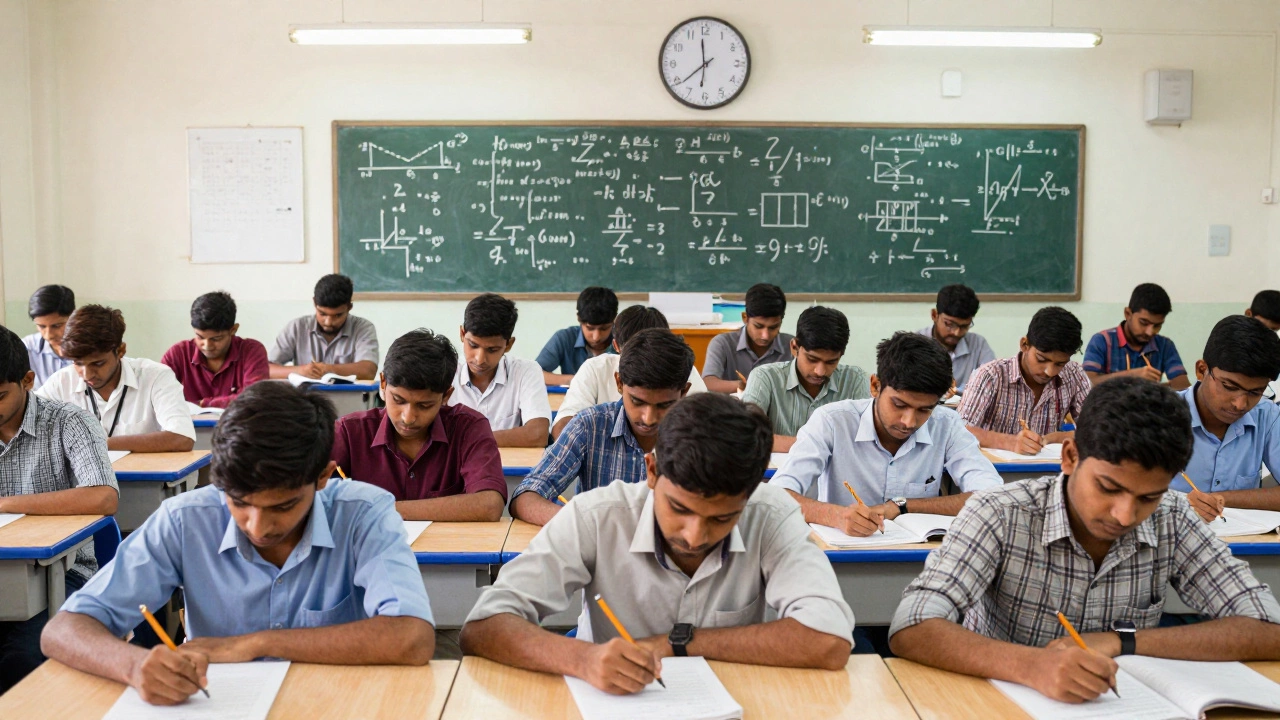
If UPSC is about power and policy, IIT JEE Advanced is about raw problem-solving speed under pressure. This exam gets you into India’s top engineering schools - the Indian Institutes of Technology. Over 250,000 students take the JEE Main. Only the top 25,000 qualify for JEE Advanced. And from those, only about 12,000 get into an IIT. The competition isn’t just fierce - it’s brutal from day one. Many students start coaching as early as 11 years old.
The exam lasts six hours, split over two days. Each paper has 54 questions, mixing multiple-choice, numerical answers, and matching types. The questions aren’t just hard - they’re designed to trick you. A single misread symbol or calculation error can cost you a top rank. One student from Jaipur told me he solved 300+ practice problems every day for two years. His sleep schedule? 4 hours a night. His diet? Energy bars and coffee. He didn’t just study for JEE. He lived it. The exam doesn’t just test math and physics. It tests how much you can endure without breaking.
CPA Exam (United States)
In the U.S., the Certified Public Accountant (CPA) exam is the gold standard - and one of the hardest professional certifications to earn. Unlike college exams, this one has real-world consequences. If you pass, you can sign off on financial statements for public companies. Fail, and you lose months of work, money, and momentum.
The CPA exam has four sections: Auditing and Attestation (AUD), Business Environment and Concepts (BEC), Financial Accounting and Reporting (FAR), and Regulation (REG). Each section is four hours long. You must pass all four within 18 months. The pass rate? Around 50% per section. That sounds okay - until you realize most candidates take 12 to 18 months just to pass all four. And it’s not just about memorizing accounting rules. You need to apply them to complex, real-world scenarios. One question might ask you to audit a multinational company’s tax structure across three countries. Another might test your knowledge of U.S. tax law changes from last year.
Unlike UPSC or JEE, the CPA exam lets you study on your own. But that’s part of the problem. Without a structured coaching system, you’re on your own. Many candidates fail not because they don’t know the material - but because they burn out. The exam doesn’t just test knowledge. It tests discipline. You need to keep showing up, month after month, even when you’re tired, stressed, or doubting yourself.
Why These Three Stand Out
What makes these exams different from others? It’s not just difficulty. It’s scale, stakes, and structure.
- UPSC tests breadth - you need to know everything from geography to ethics, and write it all out by hand.
- IIT JEE Advanced tests depth - every problem is a puzzle designed to break your speed and accuracy.
- CPA tests consistency - you have to stay sharp across four different domains, over months, with no safety net.
Other exams are hard. The Bar Exam. The GRE. The MCAT. But none of them combine the pressure, the failure rate, and the life-altering consequences quite like these three.

What They Don’t Tell You
Most people think these exams are about intelligence. They’re not. They’re about endurance. The winner isn’t always the smartest. It’s the one who shows up every day, even when they’re exhausted. The one who reviews their mistakes instead of blaming the system. The one who learns to sleep through anxiety.
There’s no magic trick. No shortcut. No app that’ll get you through. Just relentless practice, smart strategy, and the courage to try again after failure. One UPSC topper said: "I failed twice. My parents told me to give up. But I knew if I stopped now, I’d always wonder what if. So I tried again. And I won - not because I was better, but because I didn’t quit."
What If You’re Not Taking One of These?
You don’t have to take UPSC, JEE, or CPA to understand what true challenge looks like. These exams are mirrors. They show you what’s possible when you commit fully. Whether you’re studying for a local government test, a language certification, or a coding bootcamp - the same principles apply. Show up. Learn from mistakes. Keep going. That’s the real lesson behind the toughest exams in the world.
Are these the only tough exams in the world?
No, there are other extremely difficult exams, like the Bar Exam in the U.S., the Gaokao in China, or the Cambridge Law Test. But UPSC, IIT JEE Advanced, and the CPA exam stand out because of their combination of scale, failure rates, and real-world consequences. They’re not just hard - they’re life-defining.
Can you take the UPSC exam from outside India?
Yes, but only if you’re an Indian citizen. The UPSC exam is open to Indian nationals living abroad. You can register online and take the Prelims at designated centers in countries like the UAE, Singapore, or the UK. But the Mains and Interview must be taken in India. Travel and logistics add another layer of difficulty for overseas candidates.
How long do people usually prepare for IIT JEE Advanced?
Most successful candidates spend 2 to 3 years preparing, often starting in 9th or 10th grade. Full-time coaching students may study 10-12 hours a day. Many top rankers say they solved over 5,000 practice problems before the exam. It’s not just about learning - it’s about drilling until the solutions become instinctive.
Is the CPA exam harder than the Bar Exam?
It depends on your background. The CPA exam is more technical and covers four distinct areas - accounting, auditing, regulation, and business concepts. The Bar Exam focuses on legal reasoning and case law, and varies by state. Both have pass rates around 50%. But CPA requires more memorization of rules and standards, while the Bar demands deep analytical thinking. For most non-lawyers, CPA is harder to grasp. For non-accountants, the Bar is tougher.
Do you need to be a genius to pass these exams?
No. Most top scorers describe themselves as average students who got obsessed with consistency. They didn’t have photographic memories. They didn’t skip sleep. They just showed up every day, reviewed their errors, and kept improving. Intelligence helps - but discipline, routine, and resilience matter more. These exams reward persistence, not brilliance.