Indian Curriculum and US Colleges: What You Need to Know
When Indian students apply to US colleges, higher education institutions in the United States that admit international students with diverse academic backgrounds. Also known as American universities, they evaluate applicants differently than Indian entrance exams do. The Indian curriculum, the structured academic framework followed in schools across India, primarily CBSE and ICSE boards. Also known as Indian school system, it emphasizes deep subject mastery, high-stakes testing, and intense competition from an early age. This system builds strong analytical skills—especially in math and science—but US colleges don’t just want high scores. They look for well-rounded students who can think, adapt, and contribute outside the classroom.
Many Indian students assume that topping the IIT JEE, the national engineering entrance exam in India, known for its extreme difficulty and selective admissions. Also known as Joint Entrance Examination, it’s a benchmark of academic rigor in India. is enough to get into top US schools. It’s not. Admissions officers see hundreds of applicants with 99th percentile JEE ranks. What sets someone apart is how they used their time beyond textbooks. Did they build a robot? Start a tutoring group? Write code for a local NGO? US colleges care about initiative, not just marks. The CBSE, the Central Board of Secondary Education, the most widely followed curriculum in India for grades 9–12. Also known as Central Board, it’s the backbone of Indian education and the foundation most applicants come from. syllabus gives you depth, but US schools want breadth. They want to see you’ve explored interests beyond physics formulas and calculus problems.
There’s a gap between what Indian schools teach and what US colleges expect. Indian students often have excellent technical skills but lack experience in essays, interviews, or project-based learning. That’s why so many get rejected—not because they’re not smart, but because their applications look like exam prep lists, not personal stories. The good news? You can fix this. Start documenting your projects. Write about why you care about your subject. Show how you’ve solved real problems, even small ones. US colleges don’t need perfect students. They need curious, resilient ones.
Below, you’ll find real stories and practical advice from students who made the transition—from cracking JEE to getting into Stanford, MIT, and beyond. You’ll see how top IITians turned their academic discipline into something US admissions teams couldn’t ignore. You’ll learn what skills matter most in 2025, what to avoid, and how to turn your Indian education into an advantage, not a hurdle.
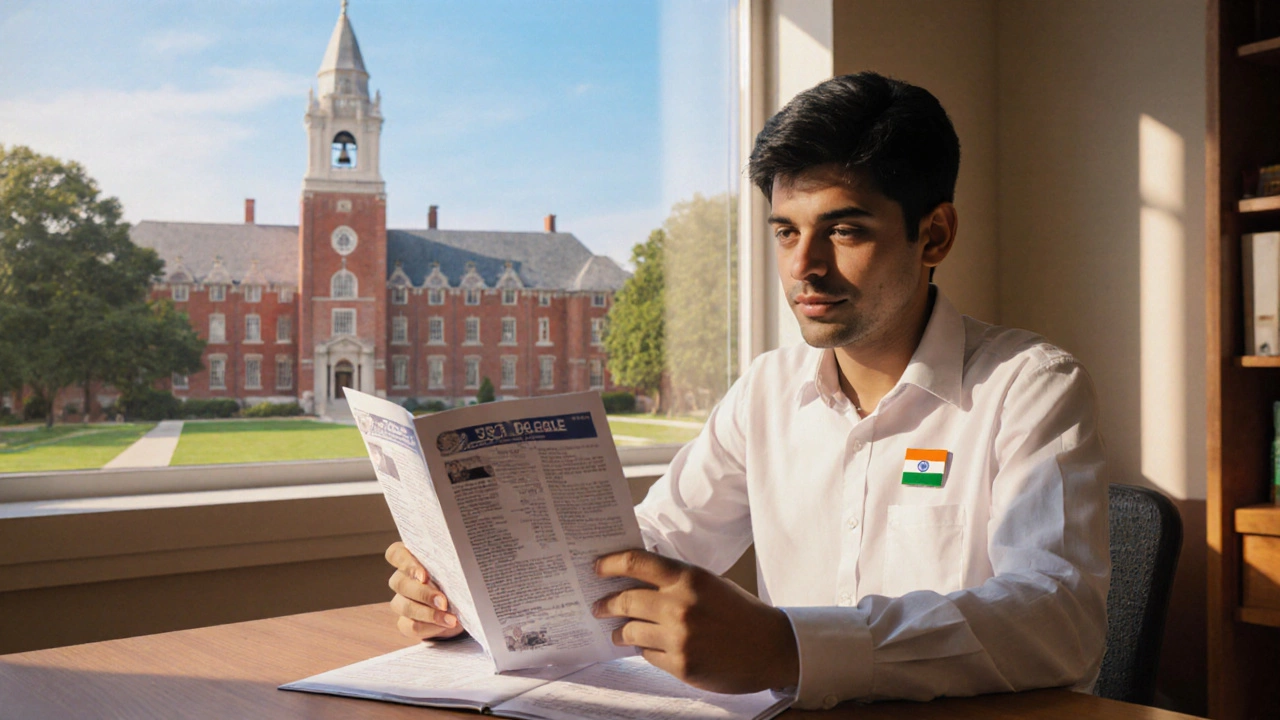
CBSE Accepted in USA? College Admissions, Recognition & Application Tips
- Arjun Rathore
- Oct, 23 2025
Find out if CBSE is accepted by US colleges, how to get it evaluated, compare with AP/IB, and follow a step‑by‑step guide for a smooth admission process.
Learn More