CBSE US Admissions: How Indian Students Navigate American Colleges
When you’re studying under the CBSE, India’s national board of education that emphasizes rigorous subject mastery and high-stakes exams. Also known as the Central Board of Secondary Education, it prepares students for intense competition in fields like engineering and medicine. But what happens when you want to apply to a university in the United States, a country where colleges evaluate students based on holistic profiles, not just test scores. It’s not just about grades—it’s about how you use them. CBSE US admissions aren’t about proving you’re the smartest. They’re about showing you’re the right fit.
American colleges don’t compare CBSE to the SAT or AP exams like you’d compare apples to oranges. They look at your transcript through a different lens. A 90% in CBSE Physics isn’t just a number—it’s proof you handled a syllabus heavier than most US high schools. But they also want to see you doing more than studying. They want clubs, projects, internships, essays that sound like you, not a coaching center template. That’s why students who do well in CBSE and still find time to build something real—like a coding app, a community initiative, or even a YouTube channel explaining tough math concepts—stand out. It’s not about being perfect. It’s about being real.
The biggest mistake? Thinking your CBSE score alone will get you in. Top US schools see thousands of Indian applicants with 95%+ in CBSE. What separates them? How you explain your journey. Did you overcome a lack of resources? Did you self-study for a science fair when your school didn’t offer labs? That’s the story that sticks. And it’s not just about Ivy Leagues. Many public universities in states like Texas, California, and Massachusetts actively recruit CBSE students because they know the rigor. You don’t need a perfect SAT if your transcript shows you mastered calculus before 16.
Some students think switching to an American curriculum like IB or A-Levels will help. But that’s not always true. Admissions officers know CBSE is harder in content depth. What they don’t know is whether you can think beyond the textbook. That’s where your projects, recommendations, and personal essays come in. They’re your chance to say: "I didn’t just memorize Newton’s laws—I used them to fix a water pump in my village." That’s the kind of detail that turns a good application into a great one.
And yes, the process is different. US colleges ask for portfolios, interviews, extracurriculars, and personal statements. CBSE doesn’t train you for that. But that’s not a disadvantage—it’s a gap you can fill. The posts below show real examples: how IITians turned their CBSE foundation into Silicon Valley careers, what US states value most in international applicants, and how distance learning helped students build skills while still preparing for JEE. You don’t need to be a genius. You just need to be clear about who you are—and what you’ve done with what you’ve got.
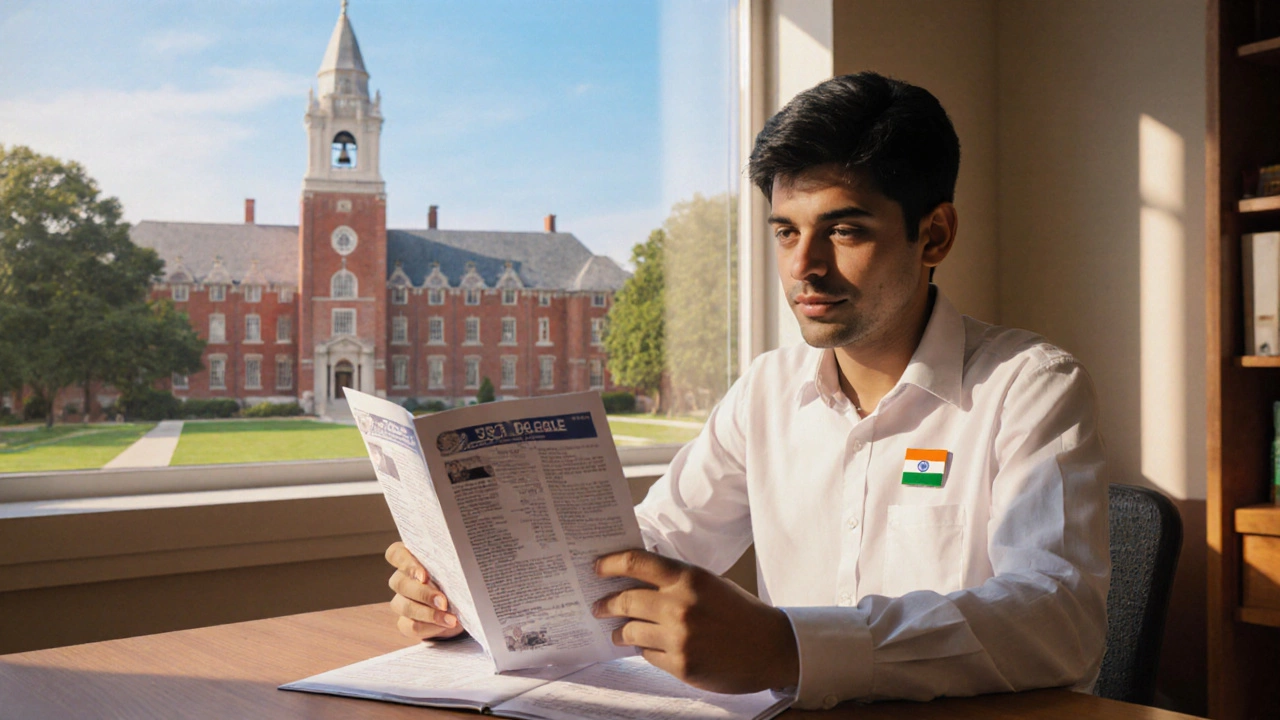
CBSE Accepted in USA? College Admissions, Recognition & Application Tips
- Arjun Rathore
- Oct, 23 2025
Find out if CBSE is accepted by US colleges, how to get it evaluated, compare with AP/IB, and follow a step‑by‑step guide for a smooth admission process.
Learn More