CBSE Recognition in USA: Does It Matter for Students Going Abroad?
When students from India apply to U.S. colleges, the CBSE, the Central Board of Secondary Education, India’s national curriculum for grades 9–12. Also known as Central Board of Secondary Education, it is one of the most widely followed school systems in the country. But does the U.S. even recognize it? The short answer: yes—but not because it’s automatically accepted. U.S. universities don’t have a list of approved boards. Instead, they evaluate CBSE based on what your transcript shows: course rigor, grades, and how well you’ve prepared for college-level work.
What really matters isn’t whether you’re CBSE or ICSE or a state board—it’s how you use your curriculum. Top U.S. colleges look for students who’ve taken challenging courses, especially in math and science. If you’ve studied Physics, Chemistry, and Math at the CBSE level and scored well, you’re already on solid ground. Many Indian students from CBSE schools get into Stanford, MIT, and UC Berkeley—not because CBSE is "better," but because they’ve shown they can handle hard material under pressure. That’s the same trait U.S. schools reward.
But here’s the catch: CBSE’s exam-heavy system doesn’t always translate directly. American colleges care about continuous assessment, projects, and extracurriculars—things CBSE doesn’t emphasize much. So if you’re applying, you need to fill those gaps. A strong SAT or ACT score helps. So does a portfolio of science fairs, coding projects, or volunteer work. Your CBSE grades open the door. Your outside activities make them want you to walk through it.
Some parents worry CBSE won’t be taken seriously in the U.S. But look at the data: thousands of CBSE students enroll in U.S. universities every year. Famous IITians who later led tech companies in Silicon Valley often came from CBSE schools. The system produced them. The U.S. didn’t reject them—they succeeded because they adapted. The key isn’t changing boards. It’s showing U.S. admissions officers you’re not just good at exams—you’re ready to think, create, and lead.
What you’ll find in the posts below are real stories and comparisons: how CBSE stacks up against American high schools, what U.S. colleges actually look for in Indian transcripts, and how students with CBSE backgrounds turned their curriculum into an advantage—not a hurdle. You’ll see why some students thrive after switching systems, and why others struggle—not because of their board, but because of what they didn’t do alongside it.
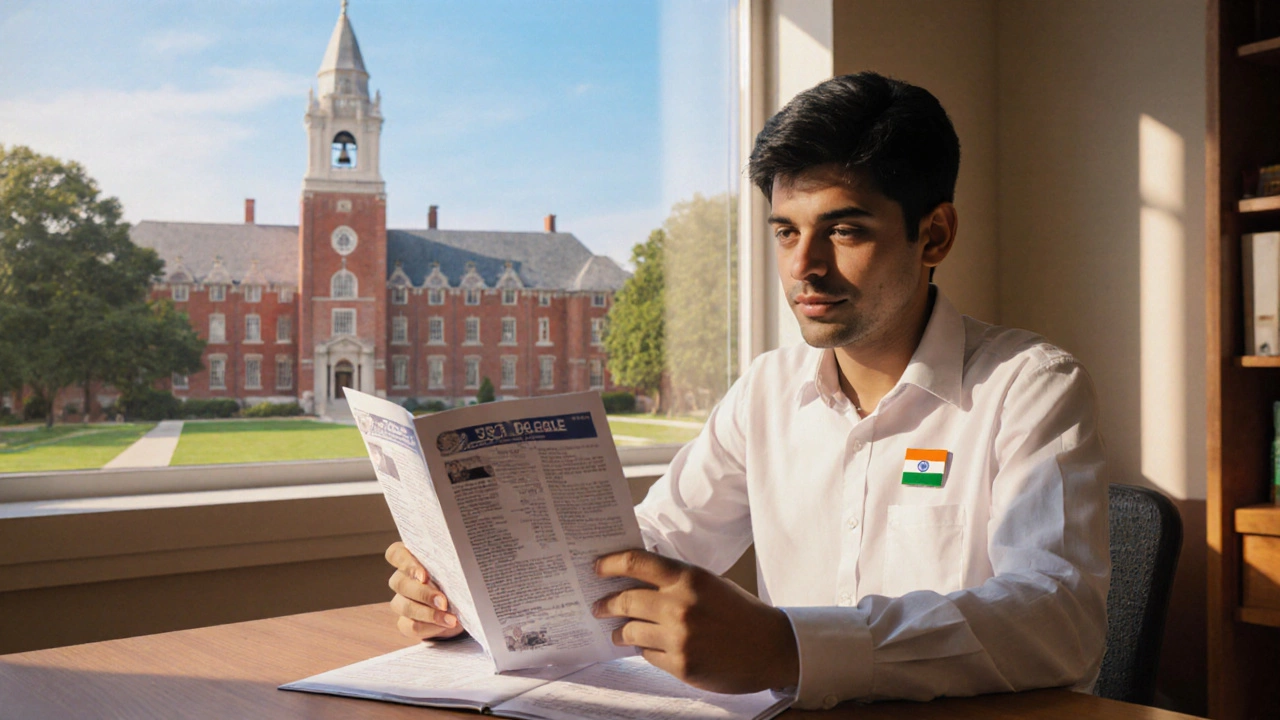
CBSE Accepted in USA? College Admissions, Recognition & Application Tips
- Arjun Rathore
- Oct, 23 2025
Find out if CBSE is accepted by US colleges, how to get it evaluated, compare with AP/IB, and follow a step‑by‑step guide for a smooth admission process.
Learn More