CBSE Equivalence USA: How Indian Boards Compare to American Schools
When you finish Class 12 under CBSE, the Central Board of Secondary Education in India, a standardized national curriculum focused on exams and subject mastery. Also known as Central Board of Secondary Education, it prepares students for high-stakes tests like JEE and NEET, not just classroom learning. Many students and parents ask: Is this accepted in the USA? The short answer is yes—but not automatically. US colleges don’t recognize CBSE the same way they do a US high school diploma. They look at course content, the actual subjects studied, depth of learning, and how well they match US standards, not just the board name. A student from CBSE with strong grades in Physics, Chemistry, Math, and English often meets the academic baseline—but they still need to prove it through standardized tests like SAT or ACT.
What really matters to US admissions officers is equivalency evaluation, a formal review by agencies like WES or ECE that maps Indian grades and curriculum to US high school equivalents. Without this, your CBSE certificate might be seen as incomplete or too theoretical. These agencies check if your 12th-grade syllabus covers the same topics as a US senior year—like calculus, biology, or US history. If your CBSE curriculum lacks certain subjects (like US government or social studies), you might need to take additional courses or pass CLEP exams to fill the gaps. This isn’t about being "better" or "worse"—it’s about alignment. Students from CBSE often outperform peers in math and science, but US schools value well-roundedness: essays, extracurriculars, leadership, and communication skills. That’s why many Indian students end up taking AP courses or online classes in English writing or economics to balance their profile.
If you’re planning to study in the US, don’t assume your CBSE record speaks for itself. Start early: get your transcript evaluated, prepare for the SAT or ACT, and build a portfolio that shows more than just scores. The posts below break down real comparisons between CBSE and American schools, show what top universities actually look for, and reveal how IITians and other Indian graduates made the transition work. You’ll find guides on credit transfer, what subjects to take next, and how to turn your CBSE background into a strength—not a hurdle—in the US system.
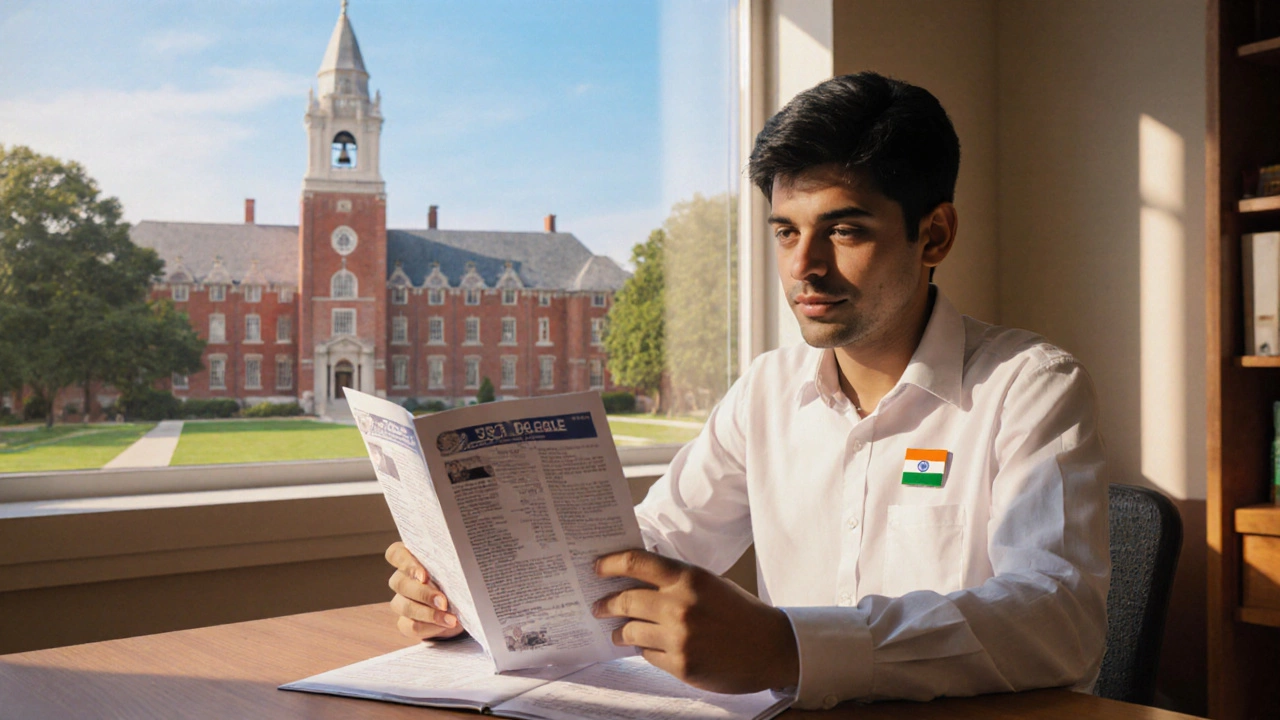
CBSE Accepted in USA? College Admissions, Recognition & Application Tips
- Arjun Rathore
- Oct, 23 2025
Find out if CBSE is accepted by US colleges, how to get it evaluated, compare with AP/IB, and follow a step‑by‑step guide for a smooth admission process.
Learn More