
NCLEX vs. MCAT: Difficulty Comparison Tool
NCLEX-RN
Licensure Exam
- Focus: Clinical Judgment & Safety
- Format: Adaptive (CAT)
- Duration: 2–5 Hours
- Goal: Pass/Fail Competency
MCAT
Admissions Exam
- Focus: Scientific Foundation
- Format: Fixed-Length
- Duration: 7.5 Hours
- Goal: Competitive Score
Select both exams to enable comparison
Head-to-Head Breakdown
The Verdict
Objective Difficulty: The MCAT is objectively harder due to requiring ~3x more study hours, a longer testing window (7.5 hrs), and broader scientific knowledge.
Subjective Stress: The NCLEX presents unique psychological stress through its adaptive format where you never know if you are passing until the end, requiring immediate clinical judgment under pressure.
Picture this: You are staring at a screen with a timer counting down. Your heart is pounding, and the question on the screen feels like it was written by someone who hates you. Now, imagine that same feeling, but the stakes are different. One path leads to becoming a registered nurse; the other opens the door to medical school. Both require passing a massive, high-stakes test. But which one is actually harder? The NCLEX or the MCAT?
This isn't just a matter of opinion. It’s about understanding two completely different types of challenges. The NCLEX-RN (National Council Licensure Examination for Registered Nurses) tests if you can safely care for patients right now. The MCAT (Medical College Admission Test) measures if you have the scientific foundation to survive four years of rigorous medical training. Comparing them is like asking if running a marathon is harder than solving a complex math puzzle. They burn different muscles.
The Core Difference: Application vs. Foundation
To understand the difficulty, you first have to look at what each exam is trying to measure. The NCLEX is an entry-level licensure exam. Its primary goal is patient safety. The National Council of State Boards of Nursing (NCSBN) designs the test to ensure that no one who fails it enters the workforce as a nurse. If you don’t know how to prioritize a bleeding wound over a routine check-up, you fail. It is practical, immediate, and binary: you are safe, or you are not.
The MCAT, on the other hand, is an admissions exam. It does not decide if you are ready to practice medicine. It decides if you are ready to *learn* medicine. The Association of American Medical Colleges (AAMC) uses the MCAT to predict your ability to handle the heavy academic load of medical school. It tests your knowledge of biology, chemistry, physics, and psychology, along with your critical thinking skills. It is theoretical, broad, and competitive. A high score doesn’t mean you can perform surgery; it means you can likely pass organic chemistry and physiology courses.
Is the NCLEX a test of memory or logic?
The NCLEX is primarily a test of clinical judgment and logic. While you need to memorize drug names and normal lab values, the questions focus on applying that knowledge to specific patient scenarios. You must decide what action to take next based on safety and priority.
Format and Structure: How the Tests Work
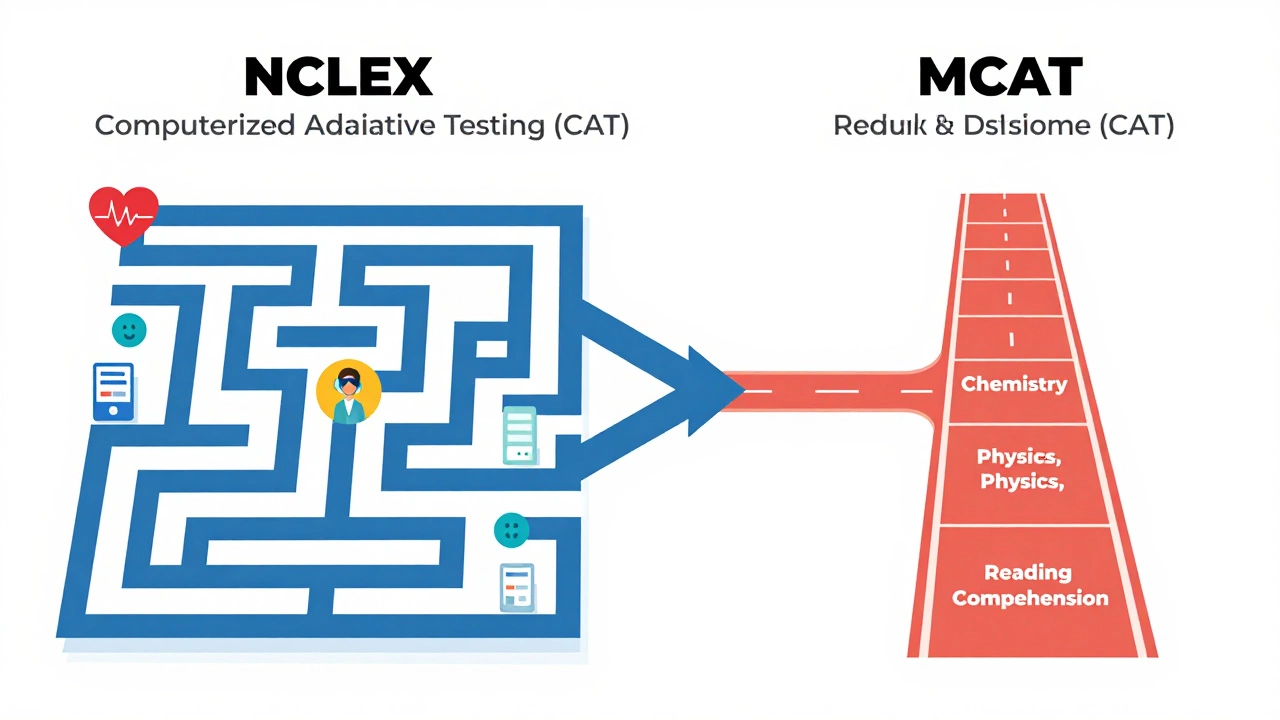
The structure of these exams contributes significantly to their perceived difficulty. In 2023, the NCLEX switched to a new testing method called Computerized Adaptive Testing (CAT) using Next Generation NCLEX (NGN) items. This means the computer adjusts the difficulty of each question based on your previous answer. If you get a question right, the next one is harder. If you get it wrong, the next one is easier. The test stops when the computer is confident, within a certain margin of error, whether you are above or below the passing standard. This can be mentally exhausting because you never know if you are doing well. You might feel like you are failing because the questions seem impossible, but that’s actually a sign you are doing great.
The NGN format also introduced new item types like matrix multiple-choice and bowtie questions, which require you to analyze trends in patient data over time. These questions simulate real-life shifts where patient conditions change dynamically. The test can last anywhere from 2 to 5 hours, depending on how quickly you reach the passing threshold.
The MCAT is a fixed-length exam. It lasts approximately 7.5 hours, including breaks. It consists of four sections: Chemical and Physical Foundations of Biological Systems, Critical Analysis and Reasoning Skills (CARS), Biological and Biochemical Foundations of Living Systems, and Psychological, Social, and Biological Foundations of Behavior. Each section is scored separately on a scale of 118-132, with a total possible score of 528. Unlike the NCLEX, there is no adaptive element. Everyone takes the same set of questions (or equivalent forms), and you have a fixed amount of time per section. The pressure comes from the sheer volume of content and the tight time limits, especially in the CARS section, which tests reading comprehension of dense, often philosophical passages.
| Feature | NCLEX-RN | MCAT |
|---|---|---|
| Purpose | Licensure to practice nursing | Admission to medical school |
| Testing Method | Computerized Adaptive Testing (CAT) | Fixed-form standardized test |
| Duration | 2-5 hours (variable) | 7.5 hours (fixed) |
| Scoring | Pass/Fail | 496-528 (total score) |
| Content Focus | Clinical judgment, patient safety | Scientific knowledge, critical analysis |
Preparation Time and Study Load
One of the biggest factors in determining "difficulty" is how much preparation is required. For most nursing graduates, the NCLEX is taken shortly after completing a bachelor’s or associate degree in nursing. Students spend their entire program preparing for this moment. Clinical rotations, simulation labs, and coursework are all designed to build the competencies tested on the NCLEX. On average, students spend 3 to 6 months reviewing specifically for the exam, using resources like UWorld or Kaplan. The study load is intense but focused. You are refining skills you already possess.
The MCAT requires a different approach. Most pre-medical students take the MCAT during their junior year of college, after completing a series of prerequisite science courses. However, the depth of knowledge required often exceeds what is taught in undergraduate classes. Students typically spend 3 to 6 months studying full-time, dedicating 20 to 30 hours per week. The content covers advanced topics in biochemistry, organic chemistry, and physics that many students haven’t seen since their sophomore year. Additionally, the CARS section requires developing a specific type of analytical reading skill that is rarely taught in traditional science curricula. This makes the MCAT preparation feel more like learning a new subject rather than reviewing old material.
A 2024 survey by the AAMC indicated that the average MCAT taker spends around 350 hours preparing for the exam. In contrast, the NCSBN reports that most nursing graduates spend between 100 and 200 hours on dedicated NCLEX review. The difference in time commitment reflects the breadth of the MCAT versus the depth of the NCLEX.
Pass Rates and Competitiveness
Statistics provide a clear window into the difficulty of these exams. The NCLEX has a first-time pass rate that varies by state and educational program type, but nationally, it hovers around 85% to 90% for Bachelor of Science in Nursing (BSN) graduates. Associate Degree in Nursing (ADN) programs often see slightly lower pass rates, around 80%. These numbers suggest that while the NCLEX is challenging, the vast majority of graduates are adequately prepared. The failure rate is low because nursing programs are accredited and rigorously evaluated to ensure their graduates meet competency standards.
The MCAT does not have a "pass" or "fail" designation. Instead, it is a competitive metric. Medical schools use MCAT scores alongside GPA, extracurricular activities, and letters of recommendation to select candidates. The average MCAT score for matriculants to allopathic medical schools in the United States is around 511 to 512 out of 528. To be competitive at top-tier institutions, applicants often need scores above 518. This creates a different kind of pressure. You are not just trying to prove you are competent; you are trying to beat thousands of other highly qualified candidates. The "difficulty" here is relative. A score of 505 might be sufficient for some schools but insufficient for others.
Furthermore, the MCAT allows retakes without penalty, though frequent retakes may raise questions for admissions committees. The NCLEX also allows retakes, but there is a waiting period (usually 45 days) and additional fees. Failing the NCLEX can delay entry into the workforce, causing financial and emotional stress. Failing to achieve a desired MCAT score delays entry into medical school, potentially requiring extra post-baccalaureate coursework.

Mental Stamina and Stress Factors
Let’s talk about the mental toll. The NCLEX is stressful because of its unpredictability. With adaptive testing, you cannot gauge your performance until the very end. You might encounter a question about pediatric dosages, followed by one about psychiatric emergencies, and then one about cardiac rhythms. The rapid switching of contexts requires strong cognitive flexibility. Many test-takers report anxiety stemming from the fear of "running out of questions," which is actually a good sign in CAT systems. The mental fatigue comes from maintaining high alertness for up to five hours without knowing if you are succeeding.
The MCAT is stressful due to its length and intensity. Sitting for 7.5 hours is physically demanding. The brain needs to switch between deep scientific reasoning in the science sections and abstract critical analysis in CARS. The time pressure is relentless. In the science sections, you have roughly 90 seconds per question, which forces quick decision-making under uncertainty. Many students describe the MCAT as a marathon that tests endurance as much as intellect. The stress is compounded by the high cost of the exam (around $330 in 2026) and the significant investment of time in preparation.
Both exams require exceptional test-taking strategies. For the NCLEX, this means mastering the "Nursing Process" (Assessment, Diagnosis, Planning, Implementation, Evaluation) and prioritizing safety. For the MCAT, it means managing time effectively, guessing strategically when stuck, and maintaining focus through long reading passages.
Which One Is Harder? The Verdict
If we define "harder" as requiring more extensive prior knowledge and longer preparation time, the MCAT is objectively more difficult. It demands a broader range of scientific expertise and higher-level critical thinking skills that are developed over several years of undergraduate education. The competition is fierce, and the stakes for admission are high.
If we define "harder" as requiring immediate, life-or-death decision-making under pressure, the NCLEX holds its own. The adaptive nature of the test and the focus on clinical judgment make it uniquely challenging. There is no room for theoretical ambiguity; you must know exactly what to do to keep a patient alive.
Ultimately, the difficulty is subjective and depends on your strengths. If you excel in sciences, enjoy deep analysis, and can sustain focus for long periods, the MCAT might feel more manageable. If you thrive in practical, scenario-based problem-solving and prefer concise, applied knowledge, the NCLEX might seem less daunting. Neither exam is easy. Both require dedication, resilience, and thorough preparation. Understanding the specific demands of each test is the first step toward conquering it.
Can I take both the NCLEX and the MCAT?
Yes, you can take both exams. Some individuals pursue dual degrees or transition from nursing to medicine (NP-to-MD pathways). However, the preparation for each is distinct. Taking both requires careful planning and significant time management, as the content areas overlap only partially.
What is the passing score for the NCLEX?
The NCLEX does not have a fixed numerical passing score. Because it uses Computerized Adaptive Testing (CAT), the passing standard is determined by a statistical model that assesses whether your ability level is above the minimum competency threshold. The result is simply Pass or Fail.
How much does the MCAT cost in 2026?
As of 2026, the fee to take the MCAT in the United States is approximately $330. Additional fees apply for international testing centers or late registration. Financial assistance may be available through the AAMC Fee Assistance Program for eligible applicants.
Do I need to retake the NCLEX if I fail?
If you fail the NCLEX, you must wait a specified period before retaking it, usually 45 days, depending on your state board of nursing regulations. You will also need to pay the examination fee again. Many candidates use this time to engage in intensive remedial study.
Is the MCAT harder than the LSAT?
Comparing the MCAT to the LSAT is complex. The LSAT focuses heavily on logical reasoning and reading comprehension, while the MCAT includes substantial scientific content. Generally, the MCAT is considered more content-heavy, whereas the LSAT is more skill-based. Difficulty perceptions vary based on individual strengths in science versus logic.