
JEE Preparation Strategy Finder
Answer these 4 questions to find out which preparation mode suits your goals and personality best.
Recommended Strategy
If you are staring at a mountain of textbooks, feeling the weight of JEE (Joint Entrance Examination) looming over your head, and wondering if Physics Wallah is the right coach to guide you through this grueling process, you are not alone. For millions of Indian students, the choice between expensive offline institutes like Allen or FIITJEE and the rising star of ed-tech, Physics Wallah (PW), feels like a gamble with their future. The promise of quality education at a fraction of the cost is tempting, but does it actually work?
The short answer is yes, but with significant caveats. Physics Wallah has disrupted the coaching industry by democratizing access to high-quality content, primarily driven by its charismatic founder, Alakh Pandey. However, whether it is "good" for you depends entirely on your self-discipline, learning style, and specific goals-be it cracking JEE Main or aiming for the top ranks in JEE Advanced.
The Rise of Physics Wallah: More Than Just an App
To understand if PW fits your needs, you first need to understand what it is. Launched in 2016 as a YouTube channel by Alakh Pandey, a physics educator known for his simplified teaching methods, Physics Wallah quickly evolved into a full-fledged ed-tech unicorn. Unlike traditional coaching centers that rely heavily on rigid classroom schedules, PW operates on a hybrid model combining live online classes, recorded lectures, and extensive study materials.
The platform’s core strength lies in its accessibility. While traditional institutes charge anywhere from ₹3 lakh to ₹5 lakh for a two-year course, PW’s flagship offerings often cost less than ₹10,000. This price difference is not just a marketing gimmick; it reflects a fundamentally different operational structure. PW leverages technology to scale its reach, allowing thousands of students to attend the same lecture simultaneously via the Ekeeda app or the dedicated Physics Wallah mobile application.
However, this scalability comes with trade-offs. The sheer volume of students means personalized attention is scarce. In a physical classroom at Allen, a teacher might notice if you are struggling with thermodynamics. On PW, unless you actively participate in doubt-solving sessions or forum discussions, you might fall through the cracks. The responsibility for tracking your progress shifts almost entirely from the institute to you.
Curriculum Quality: Does It Match the IIT Standard?
The biggest fear among parents and students considering PW is whether the curriculum is rigorous enough for JEE Advanced, India's most challenging engineering entrance exam. Let’s break down the content quality across the three core subjects.
- Physics: This is PW’s stronghold. Alakh Pandey’s approach to physics is intuitive, focusing on conceptual clarity rather than rote memorization of formulas. His explanations of mechanics and electromagnetism are widely praised for making complex topics feel manageable. For JEE Main, this is often more than sufficient. For JEE Advanced, while the concepts are solid, you may need to supplement with higher-level problem sets from books like HC Verma or Irodov, as PW’s internal modules sometimes lean towards standard difficulty.
- Chemistry: The chemistry faculty, led by experts like Mohit Tyagi and Sachin Tyagi, provides strong foundational knowledge. Organic chemistry is taught with a focus on mechanisms, which helps in understanding rather than memorizing reactions. However, some students report that the pace can be slow compared to the intensity required for top-tier JEE Advanced preparation. Physical chemistry calculations are covered well, but again, extra practice is essential.
- Mathematics: Mathematics is where opinions vary the most. PW’s math teachers are competent, but many toppers suggest supplementing PW’s lectures with resources from other platforms or traditional books like RD Sharma or Cengage. The depth of tricky integration problems and coordinate geometry questions needed for JEE Advanced might require additional exposure beyond what PW offers natively.
The study materials provided by PW, known as "PW Modules," are generally well-structured. They include theory summaries, solved examples, and practice questions. However, they are not as exhaustive as the massive question banks provided by offline giants. You will likely need to buy separate previous years' question papers and mock test series to truly prepare.
The Self-Discipline Factor: Who Thrives at PW?
Here is the hard truth: Physics Wallah is not a magic bullet. It is a tool, and like any tool, its effectiveness depends on the user. If you are looking for a system that will drag you to class every day, monitor your attendance, and pressure you into studying, PW might disappoint you.
PW works best for students who possess high levels of self-motivation. You need to be the kind of person who can watch a four-hour lecture without getting distracted by social media notifications. You need to proactively solve doubts using the community forums or live doubt sessions. If you struggle with time management or easily lose focus, the lack of physical supervision can be detrimental.
Consider this scenario: Student A joins PW, follows the schedule strictly, solves all module problems, and takes weekly tests. Student B joins PW, watches lectures passively, skips difficult problems, and rarely participates in tests. Both pay the same fee, but Student A will likely crack JEE, while Student B will not. The gap isn’t in the teaching quality; it’s in the execution.
Cost vs. Value: Is the Savings Worth It?
Let’s talk numbers. A typical two-year offline coaching package costs between ₹4 lakh and ₹6 lakh. Physics Wallah’s comprehensive courses range from ₹5,000 to ₹20,000 depending on the level (Main only, Advanced, or both). That is a saving of over 90%. For middle-class families, this is a game-changer. It removes the financial barrier that once made quality coaching exclusive to the wealthy.
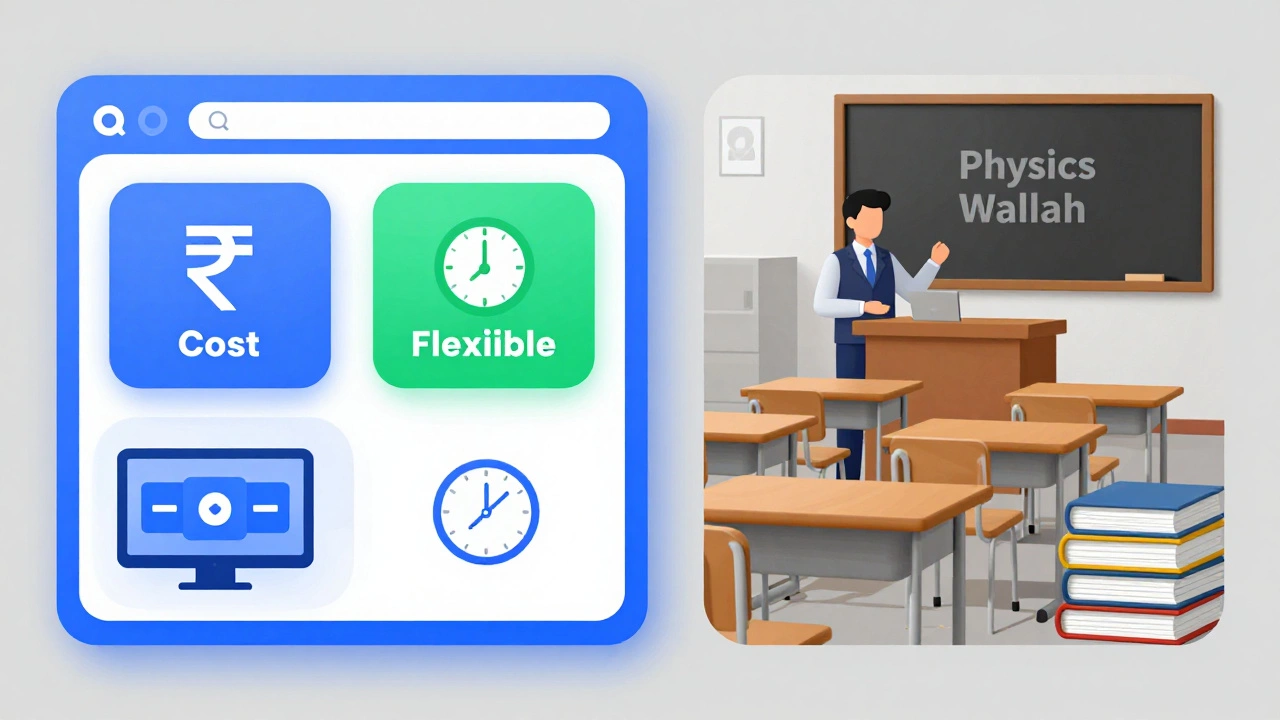
| Feature | Physics Wallah (Online) | Traditional Offline (e.g., Allen, FIITJEE) |
|---|---|---|
| Cost | ₹5,000 - ₹20,000 | ₹3,00,000 - ₹6,00,000+ |
| Personal Attention | Low (Self-driven) | High (Teacher interaction) |
| Flexibility | High (Re-watch lectures) | Low (Fixed schedule) |
| Doubt Solving | Forums/Live Sessions (Delayed) | Immediate (In-person) |
| Peer Pressure | Minimal | High (Competitive environment) |
| Study Material | Good (Modules + Digital) | Excellent (Extensive Question Banks) |
The value proposition is clear. If you can replicate the discipline of an offline environment at home, PW offers superior ROI. However, if you thrive on peer competition and need constant external motivation, the lower cost might come at the expense of performance.

Alternatives: Should You Consider Other Platforms?
While PW dominates the budget segment, it is not the only option. Depending on your learning style, other platforms might serve you better.
- Unacademy: Offers a wider variety of teachers, allowing you to switch instructors if one doesn’t suit your style. Their subscription model is flexible, but the quality can vary significantly between educators. It is good for students who want choice but requires careful selection of mentors.
- Vedantu: Known for its interactive live classes and strong focus on doubt resolution. Vedantu strikes a balance between online convenience and personal engagement, though it is slightly more expensive than PW.
- Resonance / Allen Online: These traditional giants have launched robust online programs. If you want the rigor of offline material with the flexibility of online delivery, these are worth considering. They are more expensive than PW but cheaper than full-time offline batches.
Hybrid approaches are also common. Many successful candidates use PW for conceptual lectures (especially Physics) and supplement with other sources for Math and Chemistry practice. Don’t feel locked into one platform. Use the best resources available to you.
Final Verdict: Is It Right for You?
Physics Wallah is undeniably "good" for JEE preparation, particularly for JEE Main aspirants and those who are self-disciplined. Its affordable pricing, high-quality conceptual teaching, and accessible platform make it a powerful tool for leveling the playing field. However, it is not a substitute for hard work. If you expect the platform to do the studying for you, you will fail.
If you are a visual learner who prefers concise explanations, benefit from re-watching lectures, and can manage your own schedule, PW is an excellent choice. If you need strict oversight, immediate face-to-face doubt clearing, and a highly competitive environment, consider sticking with offline coaching or a more interactive hybrid model. Ultimately, success in JEE comes from consistent effort, not just the brand name on your notebook.
Can I crack JEE Advanced solely with Physics Wallah?
Yes, it is possible, but it requires extreme self-discipline. PW’s core content covers the syllabus well, but for JEE Advanced, you must supplement it with advanced problem books like HC Verma, DC Pandey, and Irodov. Additionally, take regular mock tests from reputable sources to gauge your rank potential accurately.
Is Physics Wallah better than Allen for JEE?
It depends on your learning style. Allen offers superior structured mentorship, extensive question banks, and a competitive peer group, which is ideal for students needing external motivation. Physics Wallah offers better value for money, flexible scheduling, and excellent conceptual teaching, suitable for self-driven learners. Neither is objectively "better"; they serve different needs.
How much does Physics Wallah cost for JEE preparation?
PW offers various packages. Basic JEE Main courses can start around ₹5,000-₹10,000 per year. Comprehensive JEE Main & Advanced packages typically range from ₹15,000 to ₹25,000 for the entire duration. Free content is also available on their YouTube channel and app, though structured courses offer better organization and testing facilities.
Does Physics Wallah provide study materials?
Yes, PW provides printed modules for enrolled students. These modules contain theory notes, solved examples, and practice questions aligned with their lectures. However, many students find it necessary to purchase additional reference books and previous years’ question papers to ensure comprehensive coverage, especially for JEE Advanced.
Is the Physics Wallah app easy to use?
The PW app is generally user-friendly, offering features like live classes, recorded lectures, doubt-solving forums, and test series. However, during peak times (like exam seasons), the server load can cause lag or connectivity issues. It is advisable to download lectures for offline viewing to avoid interruptions during study sessions.