Education Quality Calculator
India Education Impact Calculator
Understand the gap between student numbers and actual learning outcomes
Your Calculations
Students who can read Grade 2 text
Job-ready graduates
What These Numbers Mean
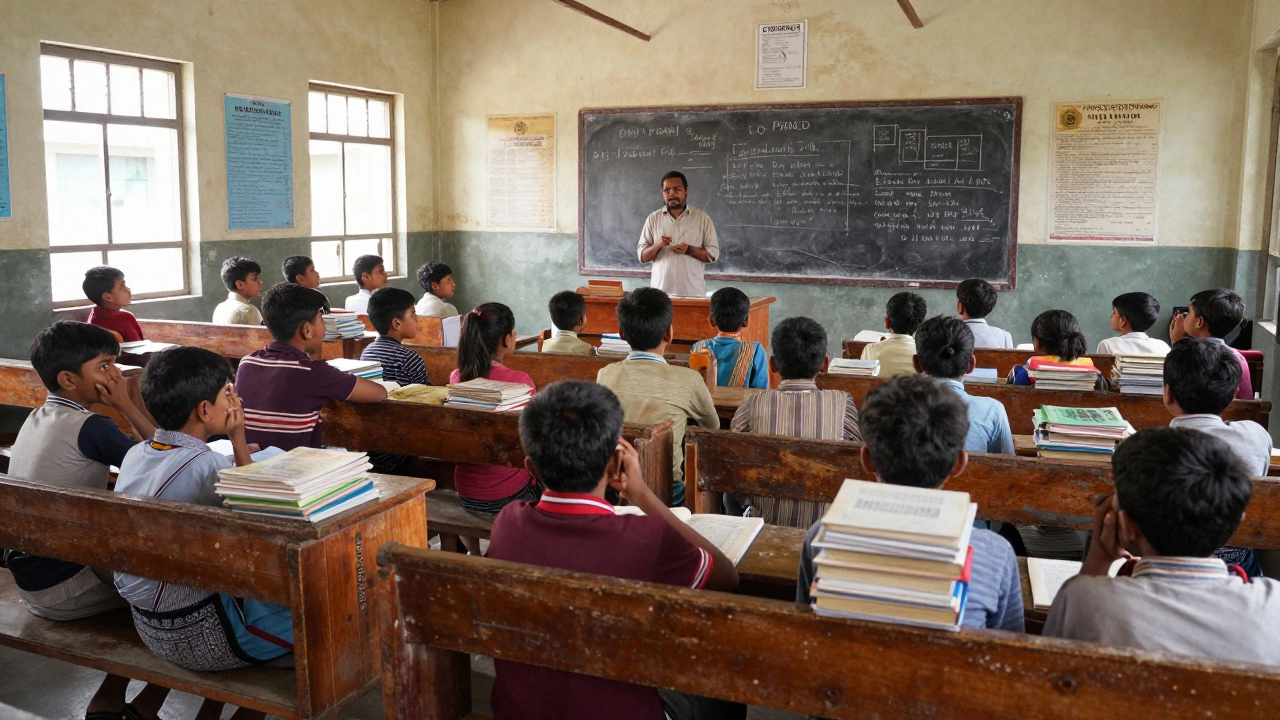
India's education system has the world's largest student population (300 million), but only half of Grade 5 students can read Grade 2 material. This shows the gap between quantity and actual learning outcomes. Only 25% of graduates are job-ready, meaning 75% need significant additional training before entering the workforce.
India has over 300 million students in its school system. That’s more than the entire population of the United States. With the CBSE syllabus taught across 20,000+ schools and millions taking competitive exams every year, it’s easy to assume India must be the most educated country on earth. But here’s the truth: education isn’t just about numbers. It’s about access, quality, and outcomes.
What does "most educated" even mean?
People throw around phrases like "most educated" like it’s a trophy. But there’s no official ranking for that. The World Bank, UNESCO, and OECD measure education differently. They look at literacy rates, years of schooling completed, tertiary enrollment, and skills applied in the workforce. India ranks 101st out of 191 countries in the UN’s Human Development Index for education. That’s behind countries like Cuba, South Korea, and even Costa Rica.India has the largest student population in the world. But having lots of students doesn’t mean they’re all learning. A 2022 ASER report found that only 50% of Grade 5 students in rural India could read a Grade 2 text. That’s not a sign of a top-tier system. It’s a sign of a system stretched thin.
India’s education system: scale vs. success
The CBSE syllabus is one of the most widely followed in India. It’s structured, standardized, and used by schools from Delhi to Dubai. But standardization doesn’t equal excellence. The curriculum focuses heavily on memorization. Exams test recall, not critical thinking. Students spend years preparing for JEE and NEET-not because they’re passionate about engineering or medicine, but because those are the only clear paths to stability.Meanwhile, countries like Finland and Singapore don’t have national entrance exams for university. They trust teachers to assess students. They focus on problem-solving, creativity, and emotional intelligence. Finland’s students consistently rank among the top in global PISA tests, even though they spend fewer hours in class than Indian students.
Higher education: degrees without skills
India produces over 15 million graduates every year. That’s more than the entire workforce of Germany. But according to the NASSCOM Employability Report 2024, only 25% of those graduates are considered job-ready in technical fields. The rest lack basic communication skills, analytical ability, or digital literacy.Why? Because degrees are handed out like certificates of attendance. Universities are underfunded. Classrooms have 100+ students. Labs are empty. Professors are overworked. The system churns out numbers, not skilled professionals.

Global comparison: who’s really ahead?
Let’s look at a few countries with better outcomes:- Japan: 99% adult literacy, 68% tertiary enrollment, lowest youth unemployment in Asia.
- South Korea: 99% secondary completion rate, top performers in math and science (PISA 2022).
- Canada: 56% of adults have a post-secondary degree-highest in the G7.
- Finland: No standardized testing until age 16. Students outperform the U.S. and India in reading, science, and problem-solving.
India’s literacy rate is 77.7% (2023 census). That’s up from 18% in 1950. Progress? Yes. Leadership? Not yet.
The myth of the "educated" Indian student
There’s a stereotype: Indian students are brilliant, hardworking, and dominate global universities. And yes, many are. But that’s not the whole story. The ones who make it abroad are often from elite families-private schools, coaching centers, English fluency, access to mentors. They’re the 5%.The other 95%? They study in government schools with no textbooks, no clean water, and teachers who show up half the time. They’re the reason India has 20% of the world’s out-of-school children.

What’s really driving the myth?
Media loves stories about Indian students winning robotics competitions or topping Harvard. These are real achievements. But they’re outliers. They don’t represent the system. When you see headlines saying "India is the most educated nation," they’re either misusing data or cherry-picking success stories.Also, India’s large population makes raw numbers look impressive. More engineers? Sure. More good engineers? Not even close. The U.S. has fewer engineering graduates, but more of them work in AI, robotics, and advanced manufacturing. Quality beats quantity every time.
Where India is actually leading
It’s not in rankings or test scores. India leads in one thing: scale of ambition. No other country tries to educate so many people with so few resources. The CBSE syllabus, the National Education Policy 2020, digital classrooms under DIKSHA-these are bold attempts to fix deep-rooted problems.And there’s progress. More girls are finishing school. More rural students are accessing online learning. Startups like Byju’s and Unacademy have brought tutoring to phones. But technology alone won’t fix a broken system. You need trained teachers, fair assessments, and real investment.
Final answer: Is India the most educated country?
No. India is not the most educated country in the world. It’s one of the most ambitious. It has the potential to be the most educated-but right now, it’s the most unequal.Real education isn’t about how many students you have. It’s about how many can think, solve problems, and create. India has millions of bright minds. But too many are stuck in a system that rewards memorization over understanding.
Until the focus shifts from exams to learning, from numbers to outcomes, the title of "most educated" will stay with countries that actually deliver results-not just enrollments.
Is India’s literacy rate the highest in the world?
No. India’s literacy rate is 77.7% as of 2023. Countries like Cuba (99.8%), North Korea (99.7%), and Lithuania (99.9%) rank higher. Even neighboring Sri Lanka (92.6%) and Bhutan (73.5%) have better or comparable rates. Literacy is just one measure-but it’s a basic one, and India still lags behind many developing nations.
Why do people think India is the most educated?
Because of visibility. Indian students who succeed abroad-especially in tech, medicine, and engineering-get featured in global media. Their stories become symbols. But they’re exceptions, not the rule. Also, India’s massive population means it produces more graduates in absolute numbers than any other country. That’s often mistaken for quality or universal access.
Does the CBSE syllabus make Indian students smarter?
Not necessarily. The CBSE syllabus is well-structured and standardized, which helps with consistency. But it’s heavily exam-focused. It emphasizes rote learning over critical thinking. Students learn to answer questions the way exams expect-not to explore ideas. Countries with better learning outcomes, like Finland and Singapore, use flexible curricula that encourage questions, projects, and real-world problem solving.
How does India compare to China in education?
China outperforms India in almost every measurable way. China’s PISA scores in math and science are among the highest globally. Its tertiary enrollment rate is 59% compared to India’s 29%. China spends 4.3% of its GDP on education; India spends 3.1%. China also has far fewer out-of-school children and better teacher training systems.
Are Indian degrees valued globally?
Top Indian institutions like IITs and IIMs are respected worldwide. But most Indian degrees-especially from private or state-run colleges-are not seen as equivalent to degrees from countries with stronger education systems. Employers abroad often require additional certifications or tests (like GRE, TOEFL) from Indian applicants, not because they doubt their intelligence, but because they can’t trust the quality of their education.
What needs to change for India to become truly educated?
Three things: First, invest in teacher training-most teachers aren’t equipped to teach critical thinking. Second, shift from memorization-based exams to assessments that measure understanding. Third, ensure every child, no matter where they live, has access to clean schools, trained teachers, and digital tools. Without these, no syllabus, no policy, and no headline will make India the most educated country.