CBSE vs American School Workload Calculator
How your study habits compare
This tool compares your daily study habits against typical CBSE and American high school workloads. Input your information to see how your workload compares to both systems.
Ever sat through a CBSE Class 12 board exam and wondered if American students have it easier? You’re not alone. Millions of Indian students and their parents compare the CBSE system to American schools, often assuming one is "harder" than the other. But the truth isn’t about difficulty-it’s about structure, expectations, and what gets measured.
CBSE is built for high-stakes exams
The CBSE syllabus is designed around two major events: the Class 10 and Class 12 board exams. These aren’t just tests-they’re gatekeepers. Your entire future, from college admissions to career paths, often hinges on how you perform on these two days. There’s no curve. No extra credit. No participation points. If you score 89% instead of 90%, you might miss a top engineering college. That pressure shapes everything.
CBSE textbooks are dense. In Class 11 Physics, you’re expected to master 15 chapters covering everything from kinematics to electromagnetic induction, with problem sets that require memorizing formulas and applying them under timed conditions. Chemistry has over 100 reactions to remember. Biology demands exact terminology-"photophosphorylation" isn’t optional vocabulary. The exam pattern rewards precision. A single miswritten word in a 5-mark answer can cost you a full mark.
American schools spread the pressure
In the U.S., there’s no single exam that decides your future. Instead, there’s a continuous assessment model. Your GPA is built from homework, class participation, quizzes, projects, midterms, and finals-all spread over four years. A student in California might have a biology grade made up of: 20% lab reports, 15% group projects, 25% unit tests, and 40% final exam. One bad day doesn’t ruin your record.
U.S. high school curricula are broader but shallower. A student might take Biology, Chemistry, and Physics-but not all in the same year. They’ll also take electives: art, drama, computer science, or journalism. There’s less pressure to master every detail of every subject. Instead, the focus is on critical thinking. An American history essay might ask: "How did the Industrial Revolution change family structures?" There’s no single correct answer. You’re graded on how well you argue your point, not how perfectly you recall dates.
Workload: CBSE packs it in, American schools stretch it out
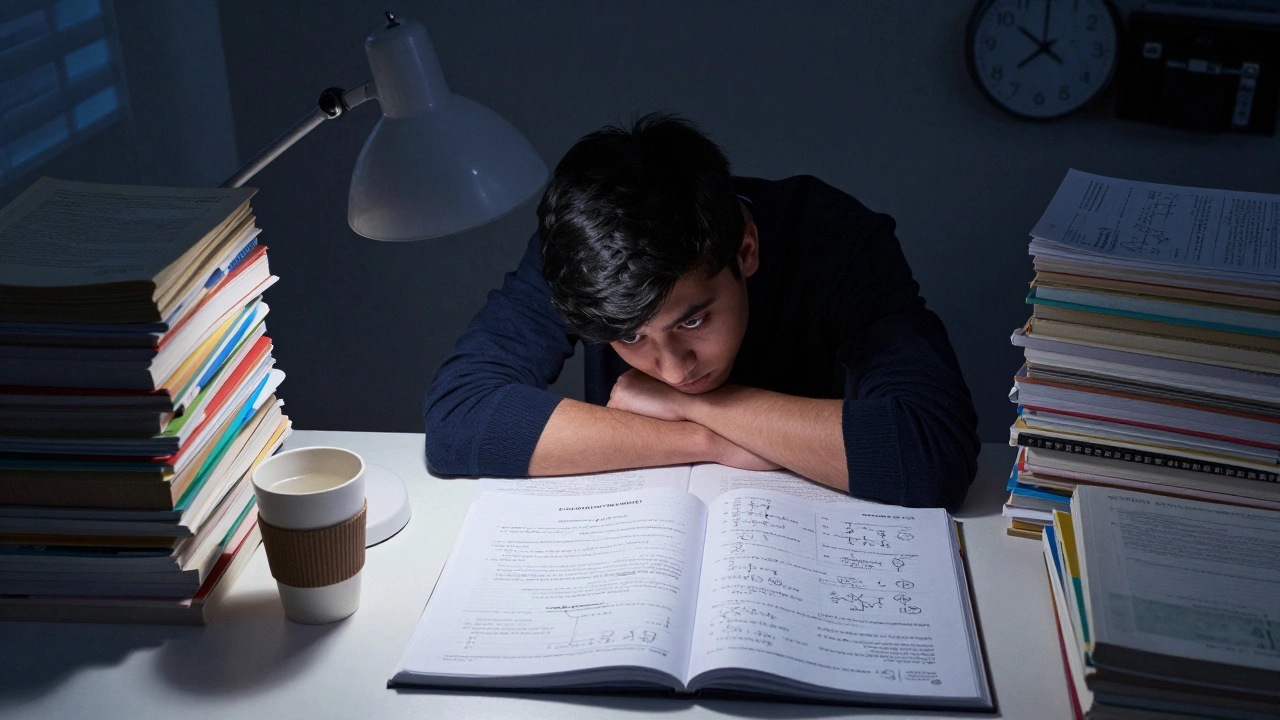
CBSE students often study 8-10 hours a day during exam season. Many attend coaching classes after school, sometimes until 9 PM. The average CBSE Class 12 student has 5 core subjects plus an optional one. Each subject requires daily practice, revision, and mock tests. Sleep becomes a luxury.
Compare that to a typical American high schooler. They take 6-7 classes per day. Each class lasts 45-90 minutes. Homework is assigned daily, but it’s rarely overwhelming. A student might spend 2-3 hours on assignments after school. They have weekends off. Extracurriculars-sports, band, debate-are not just encouraged; they’re expected for college applications. There’s no "crash course" culture. You’re not cramming for a single exam in March-you’re building a portfolio over four years.
Grading: One number vs a story
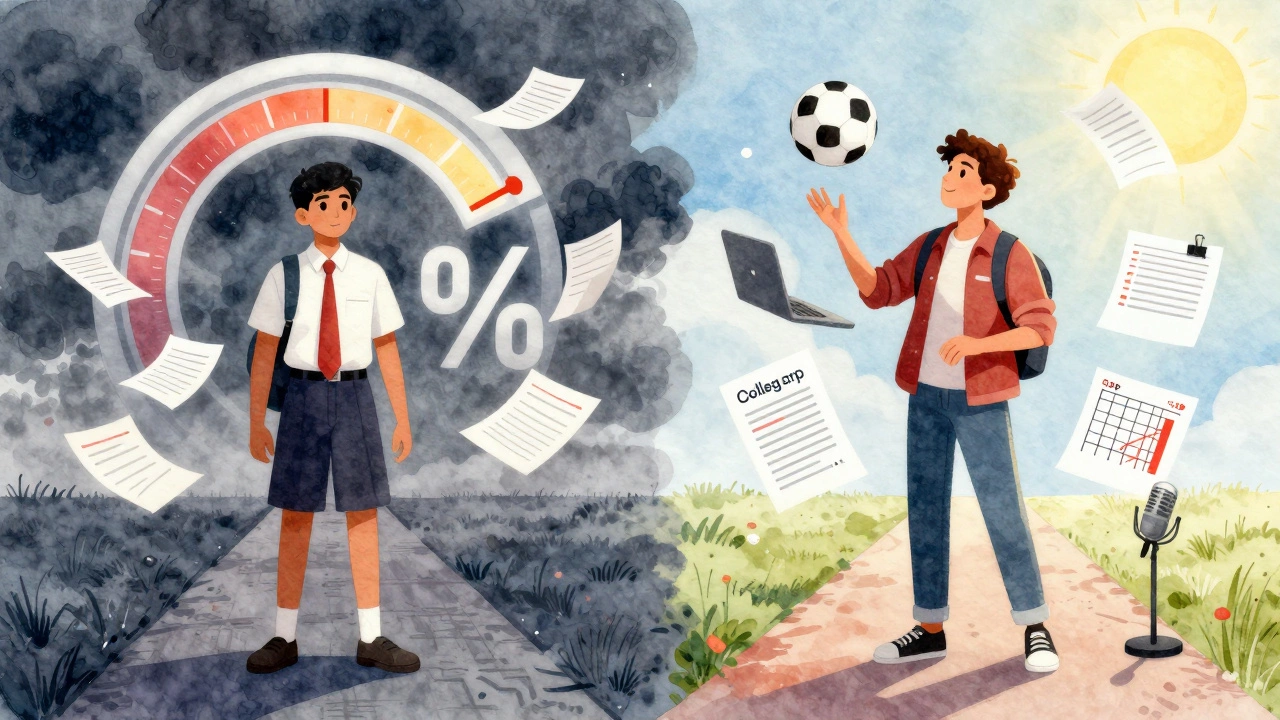
CBSE gives you a percentage. That’s it. Your entire academic identity is reduced to a single number on a sheet of paper. Colleges in India look at that number. Employers look at that number. Even your relatives ask, "What did you score?"
In the U.S., colleges see your transcript, SAT/ACT scores, letters of recommendation, personal essays, and extracurricular activities. A student with a 3.2 GPA who founded a coding club, volunteered at a hospital, and wrote a poem published in a national journal might get into MIT. A student with a 4.0 GPA who only studied and never left their room might not. The system doesn’t just measure knowledge-it measures character, initiative, and resilience.
Stress isn’t about quantity-it’s about type
CBSE stress is acute. It’s a marathon that ends in a sprint. You train for years, then face your biggest challenge in one week. If you fail, you can retake the exam-but the stigma sticks. Many students report anxiety, sleep disorders, and depression during board exam season.
American stress is chronic. It’s the slow burn of balancing AP classes, SAT prep, college applications, part-time jobs, and social life. It’s less about one big failure and more about never feeling "good enough." The pressure comes from uncertainty: "Will I get in? Will I afford it? Will I be able to pay back my loans?"
Neither system is kind. But they punish different things. CBSE punishes mistakes. American schools punish passivity.
What’s harder? It depends on what you value
If you thrive under structure, memorization, and clear rules, CBSE might feel more manageable. You know exactly what to study. You can drill until you get it right.
If you’re creative, curious, and good at managing your time, American schools give you room to breathe. You’re not just learning facts-you’re learning how to learn.
Here’s the catch: CBSE prepares you for India’s competitive exams-JEE, NEET, UPSC. If you’re aiming for engineering, medicine, or civil services in India, CBSE’s depth in math and science is unmatched. American schools don’t train you for JEE. They train you for college essays and group projects.
So is CBSE harder? Yes-if you measure difficulty by exam pressure, volume of content, and consequences of failure. But American schools are harder-if you measure it by the need to be self-driven, well-rounded, and emotionally resilient.
Real stories from real students
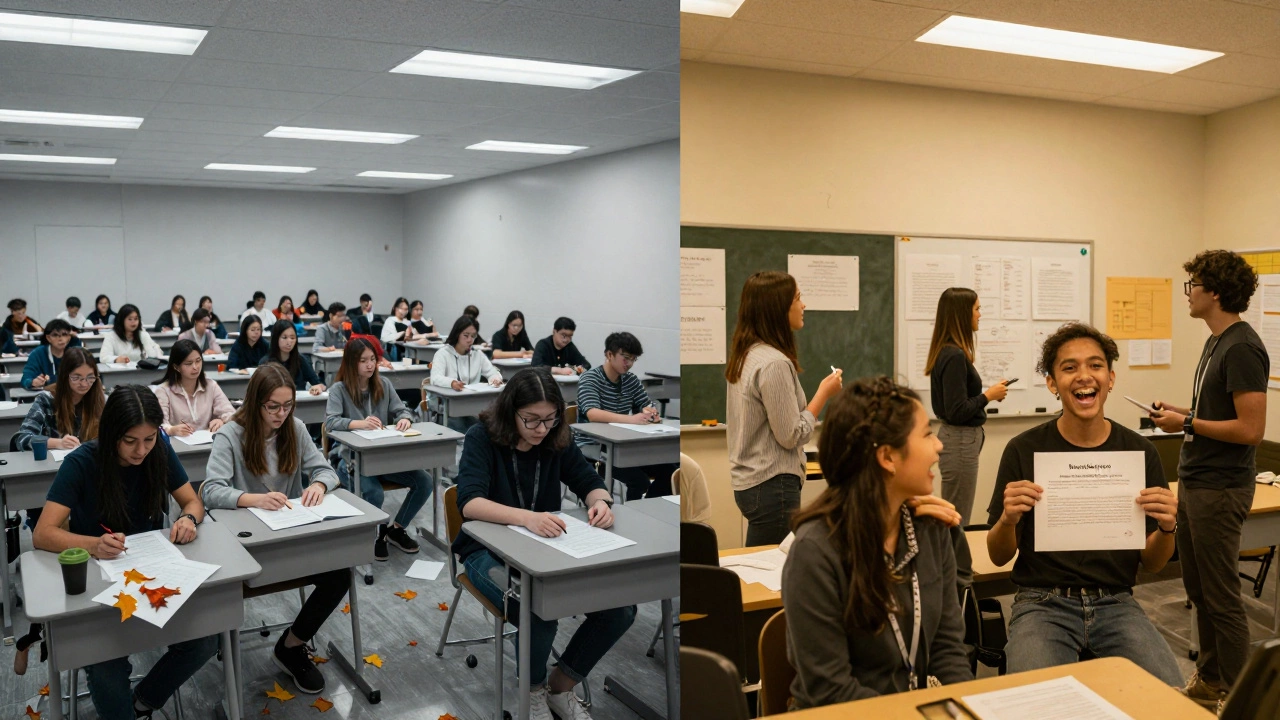
Meet Priya, 17, from Delhi. She woke up at 5 AM every day for two years. Her schedule: school until 2 PM, coaching until 9 PM, homework until midnight. She scored 94% in CBSE Class 12. She got into IIT Delhi. She hasn’t taken a day off since.
Meet Liam, 17, from Austin. He took AP Calculus, AP Environmental Science, and Creative Writing. He played soccer on weekends. He started a podcast about mental health in high school. He got a 1480 on the SAT. He was accepted to Stanford. He slept 7 hours a night.
Neither is wrong. Neither is easy.
What should you choose?
If you’re in India and planning to study engineering, medicine, or law here, CBSE gives you the tools. Stick with it. Master the pattern. Practice past papers. Don’t waste time comparing.
If you’re considering studying abroad, or you want to build a career that values creativity and communication, the American model offers more freedom. But don’t think it’s easier. It just asks different things of you.
The real question isn’t "Which is harder?" It’s: "What kind of learner are you?" And what kind of future do you want to build?
Is CBSE syllabus tougher than American high school curriculum?
Yes, in terms of content volume and exam pressure. CBSE requires deep mastery of a narrower set of subjects with high-stakes final exams. American schools cover a wider range of topics but assess through continuous performance, not one exam. CBSE is more intense in short bursts; American schools are demanding over time.
Do American students have less homework than CBSE students?
On average, yes. CBSE students often spend 4-6 hours daily on homework and self-study, especially in Classes 11-12. American high schoolers typically spend 2-3 hours per night. But American students also juggle extracurriculars, college applications, and part-time jobs, which add to their overall workload in different ways.
Is CBSE better for preparing for engineering or medical exams in India?
Yes. CBSE’s syllabus aligns directly with JEE Main, JEE Advanced, and NEET. The depth in Physics, Chemistry, and Mathematics matches the requirements of these competitive exams. Most top coaching institutes in India base their curriculum on CBSE textbooks. American curricula don’t cover these topics at the same level of rigor or speed.
Can a CBSE student succeed in U.S. universities?
Absolutely. Many CBSE students get into top U.S. universities like MIT, Stanford, and Harvard. What matters most is their SAT/ACT scores, personal essays, recommendation letters, and extracurricular achievements. CBSE students often bring strong analytical skills and discipline, which U.S. colleges value. But they need to develop communication skills and show leadership beyond academics.
Does the American system reduce stress compared to CBSE?
Not necessarily. While American schools avoid one high-stakes exam, they replace it with ongoing pressure to maintain GPA, apply to colleges, and stand out. CBSE stress is concentrated; American stress is constant. Both can lead to anxiety. The difference is in how it’s experienced-one is a sprint, the other is a long uphill climb.
What’s next?
If you’re a CBSE student, focus on mastering your syllabus. Use past papers. Understand the marking scheme. Don’t compare yourself to others-your path is valid.
If you’re considering switching to an American curriculum, prepare for a shift in mindset. Learn to write essays, not just answers. Build projects. Speak up in class. Your grades won’t be your only story.
There’s no perfect system. Only the one that fits your goals.