
Coding Progress Calculator
Your Coding Progress
Enter your daily hours and duration to see what you can achieve.
Realistic Expectations
How websites work, basic HTML/CSS structure, and simple interactivity
Simple interactive apps like to-do lists with local storage
A portfolio of 3+ projects, ready to show employers
If you’re staring at your screen wondering if squeezing in just one hour a day can actually turn you into a coder, you’re not alone. Thousands of people start coding every week with the same question: Is 1 hour a day enough to learn coding? The answer isn’t yes or no-it’s "yes, if you do it right."
What happens when you code for 60 minutes every day
One hour a day adds up faster than you think. In seven days, that’s seven hours. In a month, about 30 hours. By the end of a year, you’ve spent over 365 hours coding. That’s more than nine full workweeks. Compare that to the average person who watches 17 hours of TV a week-your hour a day is a smarter investment.
People who stick to daily coding don’t wait for motivation. They build momentum. You don’t need to spend five hours on Saturday to make progress. You just need to open your code editor every morning before coffee or right after dinner. That consistency rewires your brain. You start recognizing patterns. You remember syntax without memorizing it. You stop feeling like a beginner after three months.
What you can realistically achieve in 6 months
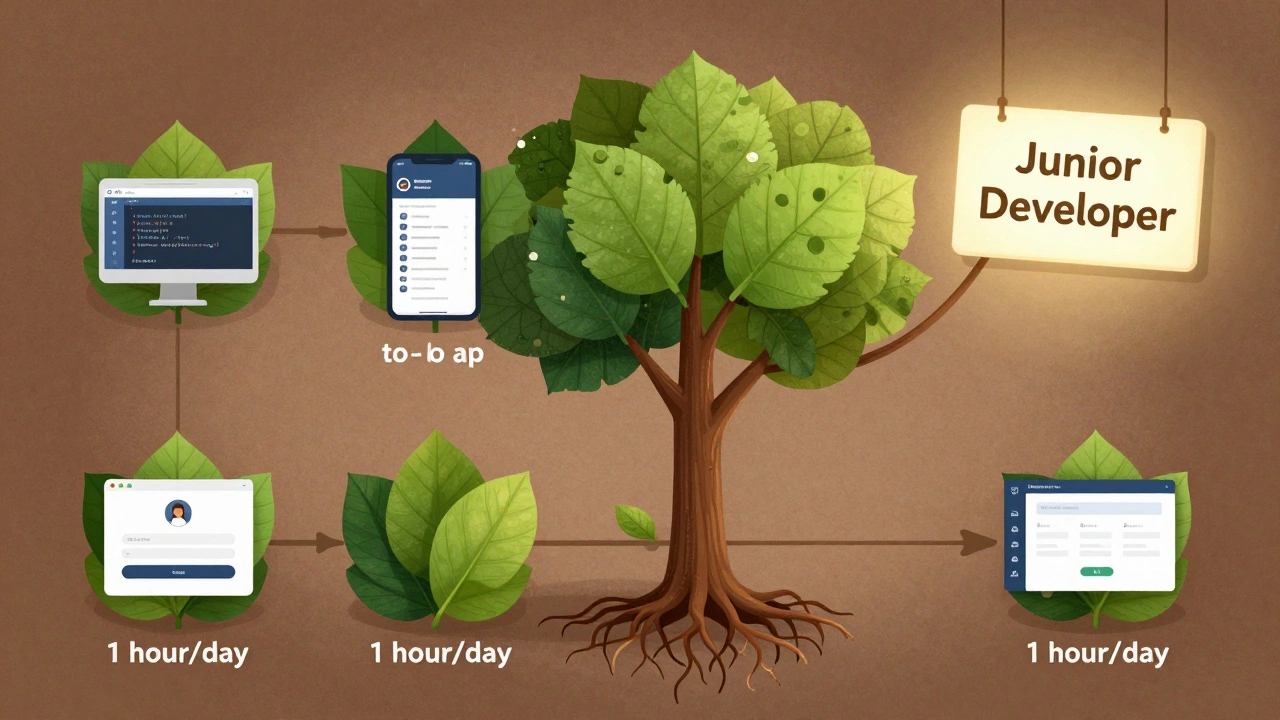
With one hour a day, five days a week, you can build real projects in six months. Here’s what that looks like in practice:
- Weeks 1-4: Learn HTML, CSS, and basic JavaScript. Build a personal homepage.
- Weeks 5-12: Add interactivity. Make a to-do list app that saves data to local storage.
- Weeks 13-20: Learn a framework like React or Vue. Turn your to-do app into a full web app with user login.
- Weeks 21-26: Build a small API with Node.js and connect it to your front end. Deploy it on Netlify or Vercel.
That’s not theory. That’s what real people have done. A teacher in Manchester started coding for an hour after her kids went to bed. Six months later, she built a website for her school’s book club and got hired as a part-time web assistant. A warehouse worker in Birmingham followed the same path. He now freelances on Upwork fixing websites.
What you won’t get in one hour a day
Let’s be honest: one hour won’t turn you into a senior software engineer in six months. You won’t master algorithms, system design, or advanced data structures. You won’t land a job at Google or Amazon without more time later on.
But you don’t need to. Most jobs don’t require that. The average front-end developer doesn’t spend their day writing sorting algorithms. They build interfaces, fix bugs, collaborate with designers, and deploy updates. Those are skills you can learn in 30-40 hours of focused practice.
What you’ll miss without more time? Deep dives into computer science theory. Long debugging sessions that teach you how systems break. But those come later-after you’ve built something real and realized you need to go deeper.
How to make every minute count
Wasting 55 minutes of your hour is easy. Here’s how to use it well:
- Start with a clear goal. Don’t say "I’ll code today." Say "I’ll build a button that changes color when clicked."
- Use free resources: freeCodeCamp, The Odin Project, or MDN Web Docs. No paywalls, no fluff.
- Code by hand. Don’t copy-paste. Type every line. Muscle memory matters.
- Break problems into tiny pieces. If you’re stuck on a loop, write out what it should do on paper first.
- End with a win. Even if you only fixed one typo, celebrate it. Progress isn’t always big.
One person I know keeps a simple log: "Today I made X work." After 30 days, he looked back and realized he’d built five mini-projects. He didn’t feel like a coder until he saw that list.
The biggest mistake beginners make
Switching languages every week.
Python? Too easy. JavaScript? Too messy. Java? Too hard. Then they go back to Python. Rinse and repeat. This isn’t learning. This is distraction.
Stick to one language for at least three months. For beginners, JavaScript is the best choice. It runs in the browser, so you see results instantly. You don’t need to install anything. Just open Chrome, press F12, and start typing. You can build a working app in under an hour.
Python is fine too-if you want to work with data or automation. But don’t jump between them. Pick one. Stick with it. Let your brain get comfortable.
When you’ll start seeing results
After 30 days: You’ll understand how websites work. You can read HTML and CSS and know what each part does.
After 60 days: You can write a simple script that responds to clicks or inputs. You’ll feel proud when your code runs without errors.
After 90 days: You’ve built something you can show someone. Maybe it’s a calculator. Maybe it’s a quiz. You’ll start thinking like a coder-not just following tutorials, but imagining what’s possible.
After 180 days: You’re no longer a beginner. You can look at a website and say, "I could build that." That’s when confidence kicks in.
What to do when you hit a wall
You will hit walls. Every single day. That’s normal.
When you get stuck:
- Don’t Google the error message immediately. Read the code line by line. Often, the fix is a missing bracket or a typo.
- Take a 10-minute walk. Your brain solves problems when you’re not staring at the screen.
- Ask for help on Reddit’s r/learnprogramming or Stack Overflow-but only after you’ve tried everything yourself.
- Remember: every expert was once stuck on the same thing you’re stuck on now.
One coder I know spent three days trying to make a form submit data. He finally figured it out because he wrote out the steps on paper: "Browser → Form → JavaScript → Server." He saw he’d skipped the server part. That’s all it took.

Can you get a job with this much practice?
Yes-if you’re smart about it.
You won’t get a job as a backend engineer at a tech giant. But you can get a job as a junior front-end developer, a web support assistant, or a freelance designer who codes. Many small businesses need someone who can fix their WordPress site or update their contact form. They don’t care if you have a degree. They care if you can fix it.
Build a portfolio. Even if it’s just three projects. Put them on GitHub. Write a short description for each: "Built this to learn form handling. Used HTML, CSS, JavaScript." That’s enough to get your first interview.
LinkedIn profiles with "Junior Developer" and a link to a GitHub repo get responses. Not because they’re perfect. Because they’re real.
What comes after one hour a day?
When you’ve been coding for six months, you’ll start wanting more. Maybe you’ll add 15 minutes in the morning. Maybe you’ll spend two hours on weekends. That’s fine. But don’t wait for "more time" to start.
The best coders aren’t the ones who have the most time. They’re the ones who showed up every day-even when they didn’t feel like it.
You don’t need to be a genius. You don’t need to be young. You don’t need a computer science degree. You just need to open your editor, type one line, and do it again tomorrow.
Is 1 hour a day enough to learn coding for beginners?
Yes, if you’re consistent. One hour a day, five days a week, gives you over 250 hours in six months-enough to build real projects, understand core concepts, and start applying for entry-level roles. The key isn’t time-it’s daily practice.
Can I learn coding without a computer science degree?
Absolutely. Most junior developers today didn’t major in computer science. They learned online, built projects, and showed their work. Employers care more about what you can do than what’s on your diploma.
What’s the best programming language to start with?
JavaScript is the best for beginners because it runs in any browser, gives instant feedback, and is used in 97% of websites. Python is a close second if you’re interested in data, automation, or AI. Pick one and stick with it for at least three months.
How long until I can build my own website?
With one hour a day, you can build a simple, functional website in about four to six weeks. Start with HTML and CSS, then add JavaScript for interactivity. You don’t need fancy tools-just your browser and a text editor.
Do I need to be good at math to learn coding?
No. Basic arithmetic is enough for most coding tasks. Logic matters more than math. If you can follow step-by-step instructions, you can code. Complex math is only needed for specialized fields like game development or machine learning-far beyond what most beginners need.
What if I miss a day?
Missing one day won’t ruin your progress. What matters is getting back on track. Don’t try to make up for lost time by coding for five hours the next day. Just do your one hour again. Consistency beats intensity every time.
Can I learn coding while working full-time?
Yes. Thousands of people do it. The key is protecting your hour. Treat it like a doctor’s appointment. Block it in your calendar. Turn off notifications. Even 45 minutes counts. You don’t need to quit your job to become a coder-you just need to show up daily.
Final thought: It’s not about time. It’s about showing up.
There’s no magic number of hours. There’s no secret technique. There’s just you, your keyboard, and the choice to start again tomorrow.
One hour a day is enough. Not because it’s a lot. But because it’s sustainable. And that’s what makes all the difference.