
Confident English Speaking Trainer
Track your streak of daily 5-minute speaking sessions. Consistency beats intensity!
Shadowing Practice Generator
Click below to generate a short script to mimic for rhythm and intonation practice.
You know the grammar rules. You can read a novel without hitting a dictionary wall. But the moment you open your mouth to speak English, your mind goes blank. It’s frustrating, right? That gap between what you know and what you can say isn’t about intelligence; it’s about neural pathways. Your brain is wired for speed and pattern recognition, not just rote memorization. To speak confidently, you don’t need more vocabulary lists. You need to rewire how your brain processes speech.
The Science Behind Speaking Anxiety
Why does your heart race when you try to order coffee in English? It’s not because you’re bad at languages. It’s biology. When you switch to a second language, your brain’s Prefrontal Cortex, responsible for decision-making and self-monitoring, goes into overdrive. Unlike your native tongue, which runs on autopilot through the basal ganglia, English requires conscious effort. This high cognitive load triggers the amygdala-the fear center-making you feel anxious or "stupid." The goal isn't to eliminate this effort immediately but to automate enough of it so your prefrontal cortex can relax.
| Brain Region | Role in Native Language | Role in Second Language |
|---|---|---|
| Basal Ganglia | Automatic processing, habit formation | Underutilized until high proficiency is reached |
| Prefrontal Cortex | Complex reasoning, low activation for simple speech | High activation, causing mental fatigue and hesitation |
| Wernicke’s Area | Language comprehension | Active but slower retrieval speeds |
Stop Translating, Start Thinking
Most learners make the fatal mistake of translating word-for-word from their mother tongue. This creates a bottleneck. You hear a question, translate it to Hindi (or Spanish), formulate an answer, translate it back to English, and then speak. By then, the conversation has moved on. To train your brain, you must bypass translation entirely. Start small. Look around your room and name objects directly in English. Don’t think "chair" and then convert it. See the object, fire the English label. This builds direct neural links between visual stimuli and English output.
Once you master naming objects, move to actions. Narrate your day like a sportscaster. "I am opening the fridge. I am taking out the milk." It sounds silly, but it forces your brain to access verbs and sentence structures in real-time. If you stumble, pause, correct yourself, and keep going. This self-correction loop strengthens the feedback mechanisms in your brain, making future errors less likely.
The Power of Shadowing Technique
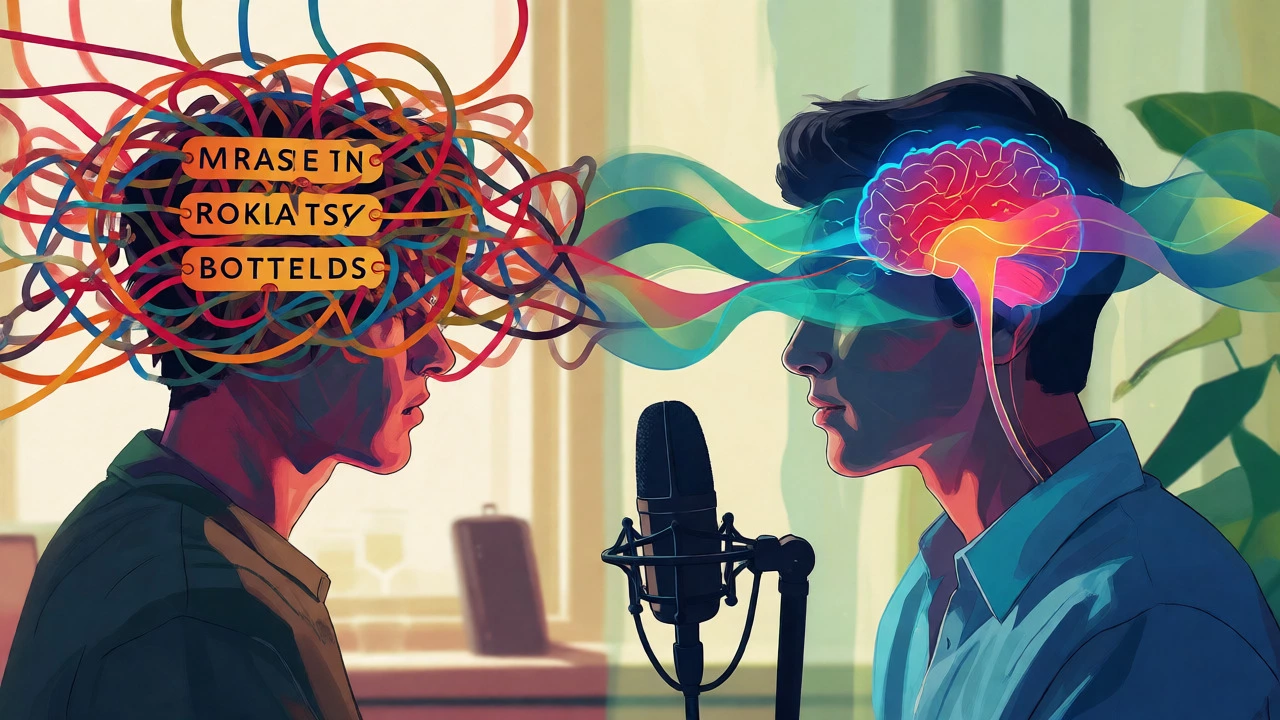
If you want to sound natural, stop studying textbooks and start mimicking humans. Shadowing is a technique used by interpreters where you listen to audio and repeat it almost simultaneously, with only a half-second delay. This isn't just about pronunciation; it trains your brain to predict sentence rhythms and intonation patterns before they finish. You aren't just copying words; you're copying the music of the language.
Here is how to do it effectively:
- Select short clips: Find a 30-second clip from a podcast or YouTube video with clear speech.
- Listen first: Play it once to understand the context.
- Mimic exactly: Play it again and speak along. Copy the pauses, the stress on certain words, and the emotion.
- Record yourself: Compare your recording to the original. Where did you rush? Where was your pitch flat?
This method reduces the cognitive load of constructing sentences because you are relying on muscle memory rather than grammatical calculation. Over time, these phrases become chunks that your brain can deploy instantly.
Embrace Imperfection and Reduce Stakes
Perfectionism is the enemy of fluency. In school, we were taught that mistakes are failures. In language acquisition, mistakes are data points. Every time you use the wrong tense, your brain registers a mismatch between intention and outcome. This error signal is crucial for learning. If you wait until you are perfect to speak, you will never speak. Lower the stakes. Talk to yourself in the shower. Record voice notes on your phone. Use AI chatbots that don't judge you. When the pressure to be perfect disappears, your brain releases the tension that causes stuttering and hesitation.
Consider using tools like Elsa Speak or generic voice assistants. They provide immediate, non-judgmental feedback. You can fail ten times in a row with an app and not feel shame. This psychological safety allows your brain to experiment with new structures without the fear of social rejection.

Contextual Learning Over Rote Memorization
Your brain struggles to recall isolated facts. It remembers stories and contexts. Instead of memorizing the word "procrastinate," remember the feeling of putting off work until midnight. Link the word to the emotion and the situation. This is called episodic memory encoding. When you later find yourself delaying a task, the emotional context triggers the word retrieval much faster than a flashcard would.
Create personal scenarios. Imagine you are complaining to a friend about traffic. What words would you use? Practice that specific scenario repeatedly. Then, imagine negotiating a salary. Practice that. By rehearsing specific life situations, you prepare your brain for the actual event. You aren't learning general English; you are learning your English.
Consistency Beats Intensity
Studying for five hours once a week is less effective than fifteen minutes every day. Neural pathways strengthen through repetition and spacing. This is known as the Spacing Effect. Short, frequent bursts of speaking practice keep the language active in your working memory. Long breaks allow the synaptic connections to weaken. Make speaking a daily ritual, like brushing your teeth. It doesn't have to be long. Just consistent.
Try the "Five-Minute Rule." Set a timer for five minutes. During this time, you must speak English continuously, even if you are just describing what you see out the window. No stopping. No switching to your native language. If you don't know a word, describe it. "It's the thing that..." This forces your brain to circumvent gaps in vocabulary, a critical skill for confident communication.
How long does it take to retrain my brain for English speaking?
It varies, but noticeable changes in confidence often occur within 4-6 weeks of daily practice. Significant neurological shifts, where speaking feels automatic, typically require 3-6 months of consistent engagement. The key factor is frequency, not duration.
Does listening help me speak better?
Yes, but passive listening isn't enough. Active listening, such as shadowing or transcribing, helps your brain internalize rhythm and syntax. However, you must produce output (speaking) to solidify these inputs into usable skills.
What if I forget words while speaking?
This is normal. Instead of panicking, use circumlocution-describing the word instead of naming it. For example, if you forget 'umbrella,' say 'the tool used to protect from rain.' This keeps the flow going and reduces anxiety.
Is grammar important for confidence?
Grammar supports clarity, but over-focusing on it hinders fluency. Prioritize being understood over being perfect. As you gain confidence, your brain will naturally refine grammatical accuracy through exposure and correction.
Can apps replace human conversation?
Apps are great for drilling vocabulary and pronunciation, but they lack the unpredictability of human interaction. To build true confidence, you eventually need to engage with real people who interrupt, misunderstand, and react emotionally.