
JEE Prep Strategy & Study Planner
Plan Your Deep Work Sessions
Allocate your daily hours across subjects. Remember: use your morning block for the toughest subject!
Preparation Readiness Tracker
Strategic Feedback:
The Quick Start Checklist
- Understand the syllabus for Physics, Chemistry, and Mathematics.
- Gather the right textbooks (NCERTs are non-negotiable).
- Create a realistic daily schedule, not an idealistic one.
- Identify your weakest subject to give it extra attention.
- Set up a quiet, distraction-free study corner.
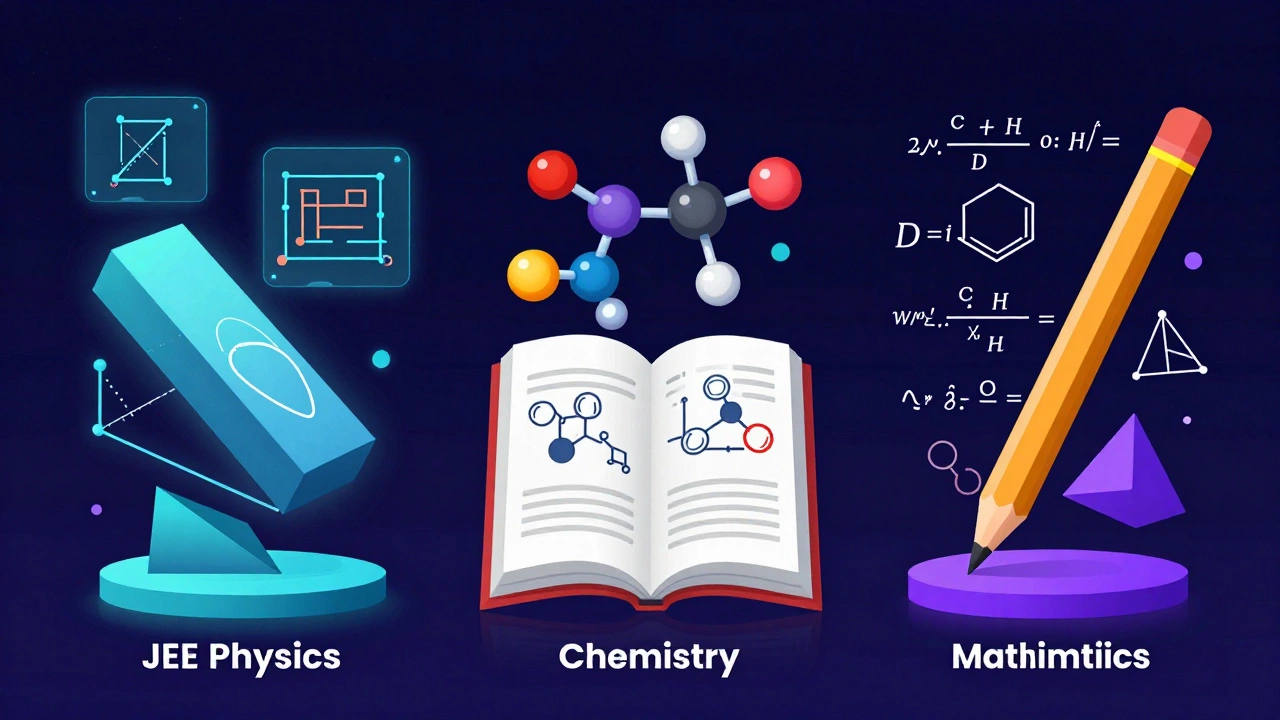
Mastering the Core Pillars: Physics, Chemistry, and Maths
You can't treat these three subjects as the same. Each requires a different mental approach. If you try to memorize Physics or solve Chemistry like a puzzle, you'll hit a wall pretty quickly.
For Physics, focus on concepts over formulas. If you don't understand why a formula exists, you won't know when to apply it in a twisted JEE question. Start with Mechanics and Thermodynamics. Use a textbook like HC Verma to build a strong foundation. The goal here is visualization; can you see the block sliding or the current flowing in your head?
In Chemistry, the game is split into three parts. Physical Chemistry is like Physics-concept-heavy. Organic Chemistry is a story; if you miss one chapter, the next five won't make sense. Inorganic Chemistry, however, is all about memory and patterns. This is where the NCERT textbooks are your best friends. Almost every line in the NCERT Chemistry book has the potential to become a question.
For Mathematics, practice is the only way out. You can't "read" Math. You have to solve it. Focus on Calculus and Coordinate Geometry. The trick here is to solve the same problem three different ways. This builds the flexibility needed for JEE Advanced, where the questions are designed to trick you.
| Subject | Primary Focus | Key Resource | Common Pitfall |
|---|---|---|---|
| Physics | Conceptual Clarity | HC Verma / Irodov | Rote learning formulas |
| Chemistry | Memory & Logic | NCERT | Ignoring Inorganic |
| Maths | Problem Solving | Cengage / RD Sharma | Reading solutions instead of solving |
Building a Study Schedule That Actually Works
Most students make the mistake of planning their day in 30-minute increments. Life doesn't work that way. A power cut, a guest visiting, or just a bad mood can ruin a rigid schedule, leading to guilt and abandonment of the plan. Instead, use a "Block Scheduling" method.
Divide your day into three blocks: Morning (Fresh mind for the toughest subject), Afternoon (Practice-heavy work to fight drowsiness), and Evening (Review and lighter topics). Give yourself a 2-hour buffer daily. If a problem takes longer than expected, the buffer saves your schedule from collapsing.
Don't forget the 80/20 rule. Roughly 80% of the exam marks often come from 20% of the most important topics. For example, in Physics, Electrostatics and Optics are high-yield. Identify these "hot spots" and master them first before diving into the obscure corners of the syllabus.
The Transition from JEE Main to JEE Advanced
Many students make the mistake of preparing for JEE Main and JEE Advanced as two separate exams. They aren't. Main is about speed and accuracy; Advanced is about depth and stamina.
In JEE Main, you might encounter 75 questions in 3 hours. You need to be a calculator. In JEE Advanced, the questions are multi-conceptual. You might need to apply a concept from Thermodynamics and Electrostatics in a single problem. To prepare for this, start solving "multiple-correct" and "integer-type" questions early. This trains your brain to not stop at the first correct-looking option.
One of the best ways to bridge this gap is through Mock Tests. Don't wait until you've finished the syllabus to take a test. Start with chapter-wise tests, then move to part-tests, and finally full-length mocks. The goal isn't the score; it's the analysis. Spend more time analyzing why you got a question wrong than you spent taking the test itself.
Common Traps and How to Avoid Them
The "Resource Trap" is the biggest killer of productivity. You'll see a YouTube video saying "Top 10 Books for JEE," and suddenly you have five different books for one subject. This leads to decision paralysis. Stick to one standard book and the NCERT. It's better to solve one book five times than five books one time.
Then there's the "Comparison Trap." You'll hear a classmate say they've finished the entire Organic Chemistry syllabus in a month. Ignore them. Everyone's pace is different. Your only competition is the version of you from yesterday. If you solved ten problems today and only five yesterday, you're winning.
Finally, watch out for the "Burnout Phase." Around the middle of the second year, many students hit a wall. They feel they aren't improving despite the hard work. This is usually because they've stopped sleeping or exercising. Your brain is a physical organ; if it's tired, it cannot process complex integration or chemical bonding. Six hours of quality sleep is more valuable than three hours of zombie-like studying.
Leveraging Technology and Online Resources
We live in an era where the best teachers in India are available on a smartphone. Use this to your advantage, but be careful. It's easy to fall into a "tutorial loop" where you watch a teacher solve 50 problems and feel like you've learned it, but you can't solve a single problem on your own. This is called the illusion of competence.
The rule is simple: For every hour of video content you consume, spend two hours solving problems manually. Use platforms like Khan Academy or dedicated JEE apps for quick concept clearances, but keep your primary focus on the pen-and-paper grind. Digital notes are great for organization, but solving a complex Physics problem on a screen is rarely as effective as doing it on a rough sheet.
When is the best time to start preparing for IIT JEE?
Ideally, starting at the beginning of Class 11 gives you a two-year window to cover the vast syllabus without extreme stress. However, many students start in Class 12. While tighter, it is entirely possible if you prioritize high-weightage topics and dedicate 6-8 hours of focused study daily outside of school.
Can I crack JEE without coaching?
Yes, it's possible. With the abundance of free resources on YouTube and online platforms, you can learn the concepts. The challenge with self-study is the lack of a structured schedule and immediate doubt resolution. To succeed, you must be extremely disciplined and join online communities to clear your doubts and track your progress via mock tests.
How many hours should I study every day?
Quality beats quantity. Instead of counting hours, count "deep work" sessions. Aim for 4-6 hours of intense, focused study on weekdays and 8-10 hours on weekends. Ensure you take a 10-minute break every 50 minutes (Pomodoro technique) to keep your brain sharp.
What should I do if I have a weak foundation in Maths?
Don't jump straight into JEE-level problems. Start with basic textbooks from Class 9 and 10 to clear your fundamentals in algebra and geometry. Once you're comfortable with the basics, move to NCERT Class 11. Trying to solve advanced problems without basics is like trying to build a house on sand; it will eventually collapse.
How do I handle the stress of JEE preparation?
Stress usually comes from a feeling of lack of control. A written plan gives you that control. Additionally, maintain one non-academic hobby-be it sports, music, or reading-to give your brain a break. Remember, your identity is more than just a rank in an exam.
Next Steps for Different Scenarios
If you are just starting in Class 11, focus on building a love for the subjects. Don't rush the syllabus; enjoy the process of solving a difficult problem. Spend the first six months mastering the basics of Vectors in Physics and Mole Concept in Chemistry.
If you are in Class 12 and feel behind, stop trying to finish everything. Use the 80/20 rule. List the most important chapters from the last five years of JEE papers and master those first. Secure your qualifying marks in JEE Main first, then pivot your entire focus to the deeper concepts required for JEE Advanced.
For those who have already completed the syllabus, your only goal should be testing. Take a full-length mock test every three days. Analyze every single mistake. If you keep making errors in the same topic, go back to the textbook and relearn that specific concept. This is called "gap-filling" and it's the fastest way to jump from a 90th percentile to a 99th percentile.