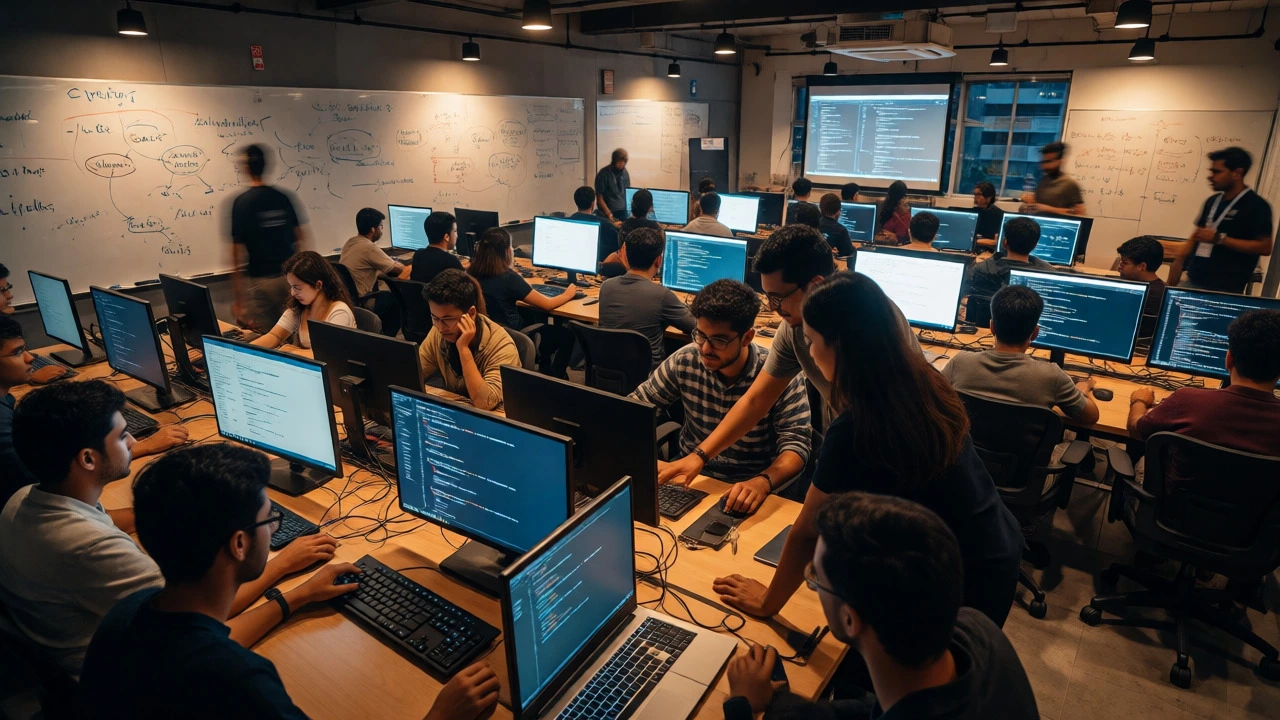
Coding Education Timeline Estimator
Select your preferred learning path and input your availability to see a realistic estimate of when you might be ready for junior developer roles.
Fill in the details and click Calculate to see your personalized timeline.
You quit your job, spent a fortune on tuition, and expected to be a senior developer in three months. Then you realize you still can't debug a simple loop without crying. The truth about coding school is messy because it depends entirely on what kind of school you choose and how fast you actually study. There is no single answer to "how long," but there are realistic timelines that won't leave you broke or burnt out.
The Three Main Paths and Their Timelines
Most people asking this question are comparing two extremes: the intense bootcamp versus the traditional university degree. But there's a third path-self-paced online learning-that sits awkwardly in the middle. Each has a different clock.
| Education Type | Standard Duration | Hours Per Week | Best For |
|---|---|---|---|
| Coding Bootcamp | 12-24 weeks | 40+ (Full-time) | Career switchers needing speed |
| University Degree | 3-4 years | 15-20 (Part-time equivalent) | Deep theoretical foundation & credentials |
| Self-Paced Online | 6-18 months | 5-15 (Variable) | Hobbyists or those keeping their day jobs |
Coding Bootcamps: The Sprint
If you want the fastest route to a junior developer role, coding bootcamps are designed to compress four years of computer science into roughly six months. Most full-time programs run for 12 to 16 weeks. That sounds short until you realize they demand 40 to 60 hours a week. You aren't just attending lectures; you're building projects every single night.
Why do some say 24 weeks? Part-time bootcamps exist for people who can't quit their jobs. These stretch the same curriculum over 6 to 9 months, requiring about 20 hours a week. The material doesn't change, but your brain gets more rest between sessions. If you have a full-time job and family commitments, trying to squeeze a 12-week full-time bootcamp into your life usually results in failure. Pick the part-time option if you need stability.

University Degrees: The Marathon
A bachelor's degree in Computer Science typically takes three years in the UK and four in the US. This isn't just about writing code. You spend the first year on math, logic, and theory before touching serious application development. The benefit here isn't speed-it's depth. When you graduate, you understand why algorithms work, not just how to copy-paste them from Stack Overflow.
Does it take longer? Yes. Does it make you employable faster? Not necessarily. Many employers care more about your portfolio than your diploma. However, if you aim for roles at big tech firms or government positions that require specific credentials, the extra two years might be worth the investment. Remember, the degree teaches you how to learn complex systems, a skill that lasts decades.
Self-Paced Learning: The Wild Card
This is where timelines get slippery. You could finish a course like CS50x in a month if you treat it like a full-time job. Or you could drag it out for two years while watching Netflix. On average, dedicated self-learners take 6 to 12 months to reach a junior-level competency. The danger here isn't time-it's consistency. Without a teacher checking your work, bad habits stick. If you go this route, set a hard deadline. Say, "I will build a deployable web app by December." Otherwise, you'll still be starting tutorials next year.

What Actually Determines Your Speed?
It’s not just the syllabus. Your background matters. If you already know basic logic or have tinkered with HTML/CSS, you’ll move through introductory modules twice as fast. If you’re starting from zero, expect the first month to feel like swimming upstream. Language proficiency also plays a role. If English isn’t your first language, technical documentation can slow you down initially. Don’t ignore soft skills either; spending time learning how to explain your code saves hours during interviews later.
Another factor: specialization. Learning Python for data analysis is often quicker than mastering C++ for system programming. Front-end development (HTML, CSS, JavaScript) tends to have a lower barrier to entry than back-end engineering involving databases and server architecture. Decide what you want to build before you start counting weeks.
Signs You’re Ready to Stop Learning
Many students suffer from "tutorial hell," where they keep buying new courses instead of building things. How do you know when you’ve learned enough to apply for jobs? Look for these markers:
- You can read error messages and fix them without Googling every single word.
- You’ve built at least two complete projects from scratch and deployed them live.
- You can explain your code decisions to a non-technical person.
- You’re comfortable using Git for version control without panicking.
If you hit these points, stop studying. Start applying. Employers hire based on ability, not certificate dates.
Is 3 months enough to learn coding?
For a full-time bootcamp student treating it like a job, yes, you can gain foundational skills. However, becoming job-ready usually requires an additional 1-3 months of project building and interview prep after the initial 3-month intensive period.
How long does it take to become a senior developer?
Coding school only gets you to junior level. Becoming a senior developer typically requires 3-5 years of professional experience on top of your educational timeline. No amount of schooling replaces real-world production experience.
Can I learn coding while working full-time?
Yes, but extend your timeline. A 12-week full-time bootcamp becomes a 24-36 week part-time journey. Expect to dedicate 15-20 hours per week. Burnout is high if you try to rush it.
Do shorter courses mean worse quality?
Not necessarily. Shorter courses focus on practical, immediate skills rather than deep theory. They are efficient for career switching but may lack the foundational breadth of a degree. Quality depends on the instructor and curriculum rigor, not just duration.
How much time should I practice daily?
Consistency beats intensity. Two hours of focused practice daily is better than ten hours once a week. Muscle memory and logical thinking develop through regular repetition.