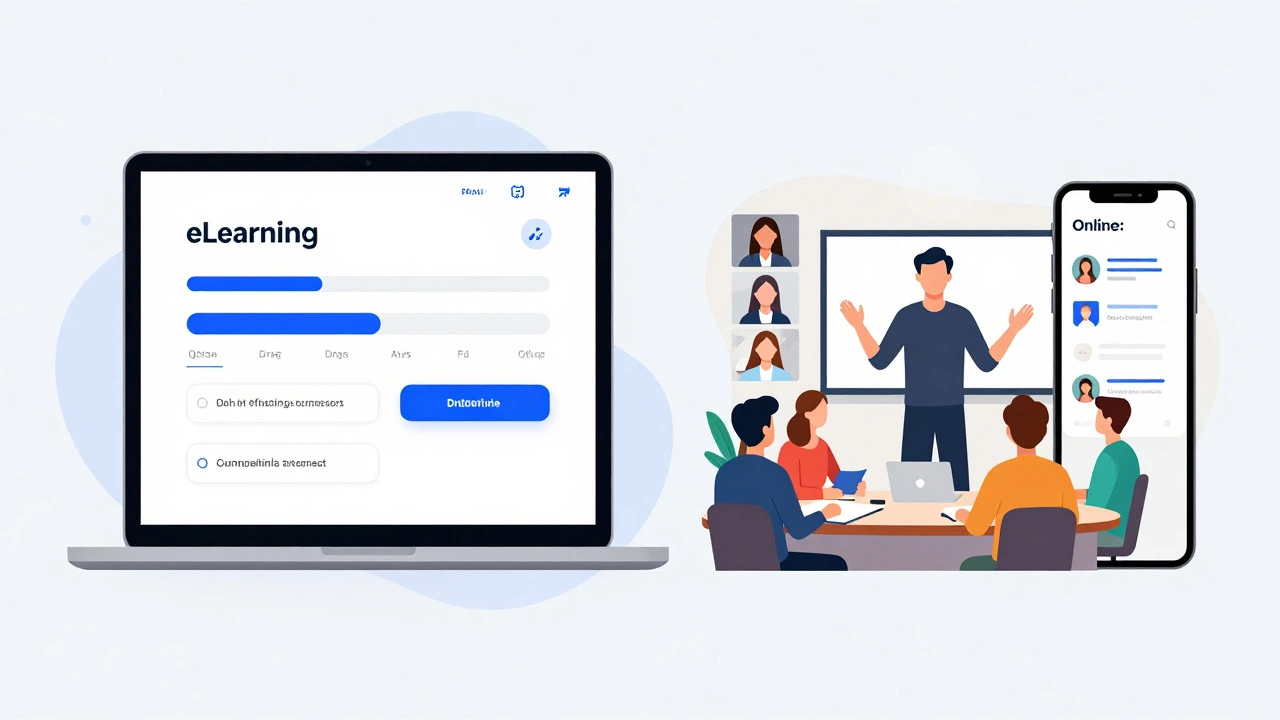
Learning Style Decision Tool
Answer the following questions about your learning needs to determine which approach is best for you.
Recommended Approach
Online Learning
Best for degrees, complex subjects, and social interaction.
- Live Instructor Interaction
- Peer Community & Networking
- Structured Schedule
- Deep Subject Mastery
eLearning
Best for quick skills, compliance, and maximum flexibility.
- Self-Paced Asynchronous
- Automated Grading
- Scalable & Efficient
- Specific Skill Acquisition
You’ve probably seen the terms eLearning and online learning used interchangeably. Job postings say "experience with eLearning platforms," while university brochures advertise "fully online learning programs." It feels like splitting hairs, right? But if you’re trying to choose a course, build a training program, or just understand how modern education works, that distinction actually matters.
The short answer is that they are not the same thing. One is a broad category of delivery, and the other is a specific method of instruction. Understanding this difference helps you pick the right tool for your goals, whether you’re a student looking for flexibility or an employer designing staff training.
The Core Definition: Delivery vs. Method
To clear up the confusion, we need to look at what each term actually describes. Think of it like food. Online learning is education delivered via the internet. It’s the channel. Just as "delivery" can mean pizza arriving at your door from any restaurant, online learning means accessing educational content through a web browser or app. The focus is on the where and how you get the information.
eLearning, on the other hand, is electronic learning using structured digital resources. This includes interactive modules, simulations, quizzes, and multimedia presentations. It’s the what. You can have eLearning without being online (like watching an instructional video on a USB drive), but in today’s world, eLearning almost always happens online.
The key difference lies in structure. Online learning often implies a broader educational experience, such as a degree program or a live webinar series. eLearning usually refers to self-paced, modular content designed for skill acquisition or compliance training. If you are taking a four-year bachelor’s degree where you attend live Zoom lectures and submit essays, that is primarily online learning. If you are completing a mandatory cybersecurity module at work that involves clicking through slides and passing a quiz, that is eLearning.
Interactivity and Engagement Models
How do you interact with the material? This is where the two concepts diverge significantly in practice.
Online learning frequently emphasizes human connection. Even though it happens over the internet, many online courses rely on synchronous interaction. This means real-time engagement between students and instructors. You might join a virtual classroom at 9 AM on Tuesdays, participate in breakout room discussions, and email your professor directly for feedback. The value here isn’t just the content; it’s the community and the guidance.
eLearning tends to be asynchronous and automated. The system delivers the content, tracks your progress, and grades your responses instantly. There is little to no direct human interaction during the learning process. Instead, the interactivity comes from the software itself. You drag and drop items to match categories, watch a video that pauses to ask a question, or complete a scenario-based simulation. The goal is efficiency and consistency. Every learner gets the exact same experience, regardless of when they log in.
This difference affects how engaged you feel. If you thrive on debate and mentorship, pure eLearning might feel isolating. If you hate waiting for replies and prefer to learn at 2 AM, eLearning is likely more appealing than a rigid online class schedule.
Technology and Platform Requirements
The tools required for each approach differ based on their goals. Online learning platforms often resemble traditional school environments digitally. They need robust video conferencing capabilities, discussion forums, assignment submission portals, and grade books. Platforms like Blackboard, Canvas, or Moodle are built to support this complex ecosystem of social and academic interaction.
eLearning relies heavily on Learning Management Systems (LMS) optimized for content delivery and tracking. These systems use standards like SCORM (Sharable Content Object Reference Model) or xAPI (Experience API) to ensure that modules created by one vendor work seamlessly within another’s platform. The technology focuses on data: Did the user finish the module? Did they pass the quiz? How long did they spend on each slide? Tools like Articulate Storyline or Adobe Captivate are used to create these interactive experiences, which are then hosted on LMS platforms like Cornerstone OnDemand or Docebo.
| Feature | Online Learning | eLearning |
|---|---|---|
| Primary Tool | Video Conferencing + LMS | LMS + Authoring Tools |
| Interaction Type | Synchronous (Live) | Asynchronous (Self-Paced) |
| Data Focus | Grades, Participation | Completion Rates, Compliance |
| Content Format | Lectures, Discussions | Modules, Simulations, Quizzes |
Use Cases: Who Uses What?
Knowing who uses these methods helps clarify why the distinction exists. Online learning has become the backbone of higher education expansion. Universities offer fully online degrees because it allows them to reach global audiences without physical campus constraints. Students take online learning when they want credentials, networking opportunities, and deep dives into subjects like history, engineering, or business administration.
eLearning dominates the corporate sector. Companies use it for onboarding new employees, ensuring staff meet safety regulations, and teaching product knowledge. Why? Because it scales effortlessly. A company with 10,000 employees across five time zones can push an updated privacy policy module to everyone at once. They don’t need to hire thousands of trainers. They just update the digital asset. This makes eLearning ideal for standardized, repetitive, or compliance-driven topics.
However, the lines are blurring. Many universities now embed eLearning modules within their online degree programs. You might watch a recorded lecture (eLearning style) before attending a live seminar (online learning style). This hybrid approach leverages the efficiency of eLearning with the depth of online learning.
Cost and Accessibility Implications
From a financial perspective, eLearning is generally cheaper per learner. Once the initial investment in creating the digital content is made, the marginal cost of adding another user is near zero. There are no travel expenses for instructors, no venue rentals, and minimal ongoing administrative overhead. This low barrier to entry makes eLearning accessible to organizations with tight budgets.
Online learning can be more expensive due to the human element. Live instructors command higher salaries than static content. Technical support for live streaming and interactive sessions requires more robust IT infrastructure. However, online learning can still be more affordable than traditional brick-and-mortar education because it eliminates commuting costs and campus fees for students.
Accessibility also varies. eLearning modules must be designed with universal design principles to accommodate users with disabilities, such as screen reader compatibility for visually impaired learners. Online learning classes need to provide transcripts for live videos and flexible scheduling for those with caregiving responsibilities. Both require intentional design to be truly inclusive.
Choosing the Right Approach for Your Goals
So, which one should you choose? It depends entirely on your objective.
- Choose Online Learning if: You want a degree, certification, or credential that requires peer interaction and instructor feedback. You benefit from structure, deadlines, and community accountability. You are studying complex subjects that require discussion and debate to fully grasp.
- Choose eLearning if: You need to acquire a specific skill quickly, such as using new software or understanding a legal requirement. You prefer flexibility and want to learn at your own pace. You are part of an organization that needs to train large groups consistently and efficiently.
In reality, most people encounter both. You might take an online marketing course to earn a certificate, which includes several eLearning modules on SEO basics. Recognizing the difference helps you manage your expectations. Don’t expect deep personal mentorship from a self-paced compliance module. Don’t expect instant automated grading in a live seminar class.
As technology evolves, artificial intelligence is making eLearning more personalized, while virtual reality is bringing immersive elements to online learning. The boundary will continue to blur, but the core distinction remains: one is about the electronic delivery of structured content, and the other is about the internet-enabled access to education.
Is eLearning the same as distance learning?
Not exactly. Distance learning is the broadest term, referring to any education where teacher and student are separated by distance. This could include correspondence courses by mail. eLearning is a subset of distance learning that specifically uses electronic devices and digital media. All eLearning is distance learning, but not all distance learning is eLearning.
Can I get a degree through eLearning?
You can complete parts of a degree through eLearning modules, but a full degree is typically considered an online learning program. Degrees require assessment, accreditation, and often human evaluation of complex work, which goes beyond standard eLearning structures. Most accredited online degrees blend eLearning content with online learning interactions.
Which is better for beginners: eLearning or online learning?
For absolute beginners who struggle with self-discipline, online learning with live instructors is often better. The external accountability and ability to ask questions in real-time prevent frustration. For tech-savvy learners who know how to navigate digital interfaces, eLearning offers a faster, less intimidating way to start acquiring new skills without the pressure of a live audience.
Do employers value eLearning certificates?
It depends on the industry. In fields like IT, project management, or compliance, specific eLearning certifications are highly valued because they prove practical, up-to-date skills. In creative or leadership roles, employers may place more weight on degrees or portfolios developed through comprehensive online learning programs that demonstrate critical thinking and collaboration.
What is the future of eLearning versus online learning?
The future is convergence. AI tutors will make eLearning more adaptive and conversational, bridging the gap with human instruction. Meanwhile, online learning will incorporate more gamified eLearning elements to keep students engaged. The distinction will remain useful for procurement and design, but for end-users, the experience will increasingly feel like a seamless blend of both.