Harvard Admissions Calculator for CBSE Students
Every year, thousands of Indian students with CBSE backgrounds wonder: Does Harvard accept CBSE? The answer isn’t a simple yes or no - but it’s far from impossible. Harvard doesn’t have a list of approved boards. Instead, it looks at what you’ve done with your education, not just which board issued your certificate.
Harvard Doesn’t Care About the Board - But It Cares About Your Performance
Harvard’s admissions team reviews applications from over 100 countries. They’ve seen CBSE, ICSE, state boards, IB, A-Levels, and more. What matters isn’t the name on your transcript - it’s how well you’ve mastered the material and how you’ve stood out.
A student from Delhi with 95% in CBSE Class 12 isn’t automatically accepted. Neither is a student with 82% automatically rejected. Harvard looks at context. If you’re at the top of your class in a highly competitive school, that’s meaningful. If you’ve taken the hardest subjects available - Physics, Chemistry, Math, Computer Science - and aced them, that tells a story.
Harvard’s admissions officers know CBSE is one of the most rigorous boards in India. They understand the pressure, the exam format, the competition. They’ve reviewed thousands of CBSE applications. They’re not surprised by high scores. What surprises them is what you did beyond the textbook.
What Harvard Actually Looks For in CBSE Applicants
Harvard doesn’t just want top grades. They want students who show depth, curiosity, and initiative. Here’s what stands out:
- Subject mastery: Did you take the most challenging courses available? CBSE offers Physics, Chemistry, Biology, Math, Computer Science, Economics, Psychology - taking 3-4 of these at the highest level shows academic courage.
- Standardized test scores: SAT scores above 1500 or ACT above 34 are common among admitted students. TOEFL 110+ is expected if English isn’t your first language.
- Extracurricular depth: One deep commitment beats ten shallow ones. Did you start a coding club? Publish research? Win a national science fair? Lead a community project? Harvard wants to see ownership.
- Essays that reveal character: Your personal statement should answer: Who are you when no one’s watching? What drives you? What have you learned from failure?
- Recommendations that speak to impact: A teacher who says, “She led 50 students in a free tutoring program for underprivileged kids,” carries more weight than one who says, “She got top marks.”
Many CBSE students focus too much on marks and miss the bigger picture. Harvard doesn’t need another 98% scorer. They need someone who turned a classroom idea into a real-world project.
How CBSE Compares to Other Curricula
Some parents worry CBSE is “not as good” as IB or A-Levels. That’s a myth. Harvard treats all curricula equally - but they evaluate them differently.
IB students often have extended essays and CAS hours built in. A-Level students specialize early. CBSE students usually take a broader range of subjects with heavy emphasis on exams. Harvard knows this. They don’t penalize you for not having IB - they look at what you did within your system.
Here’s how Harvard sees the differences:
| Curriculum | Typical Strength | What Harvard Looks For |
|---|---|---|
| CBSE | Strong foundational knowledge, exam discipline | Depth in STEM subjects, leadership beyond academics |
| ICSE | Broad curriculum, emphasis on English | Critical thinking, writing ability, interdisciplinary projects |
| IB | Research skills, global perspective | Extended Essay quality, CAS impact |
| A-Levels | Specialization, depth in 3-4 subjects | Subject mastery, independent study |
The key takeaway? Don’t compare your board to others. Focus on maximizing what you have. If you’re in CBSE, use the structure to build something unique.
Real Examples: CBSE Students Who Got Into Harvard
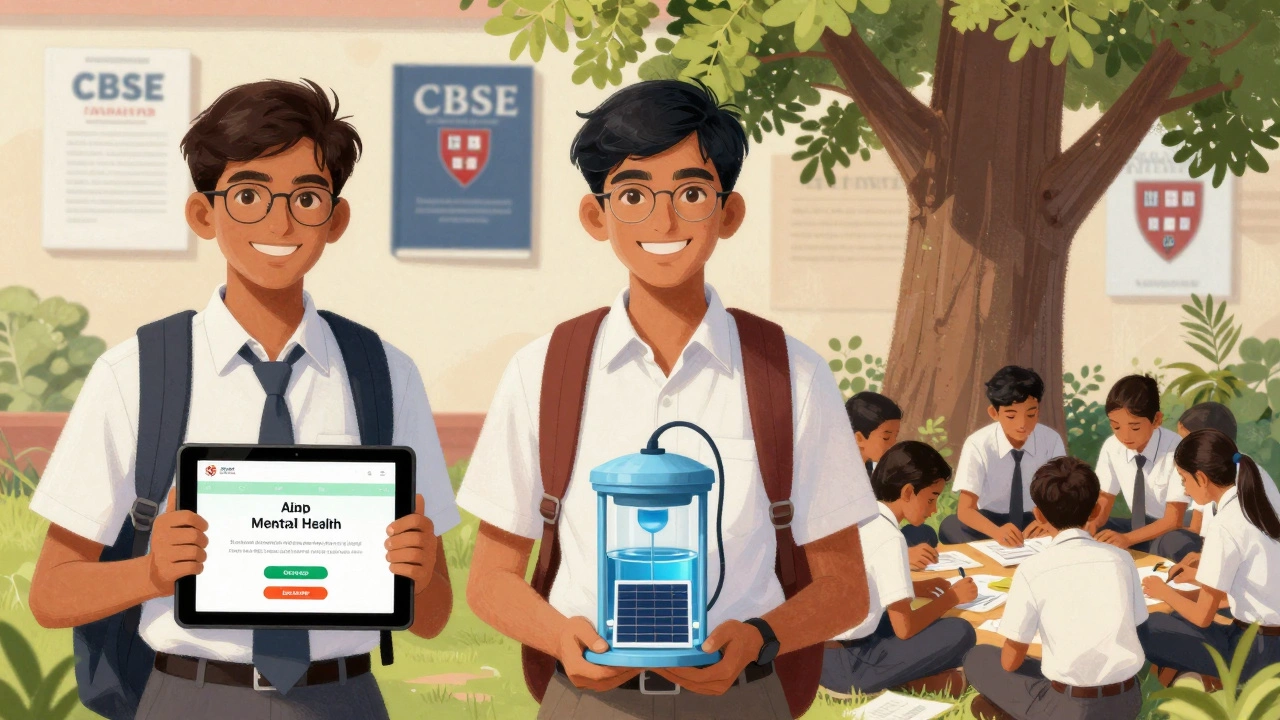
In 2024, Harvard admitted 17 Indian students with CBSE backgrounds. Here’s what two of them had in common:
- Student A: From a government school in Patna. Scored 94.2% in CBSE. Didn’t attend coaching. Built a free online platform teaching physics to rural students. Got 1500+ users in 6 months. Won a national innovation award. SAT: 1550. Essay: “How I Taught Myself to Teach.”
- Student B: From a private school in Hyderabad. Scored 91.8%. Took Biology, Chemistry, Math, and Computer Science. Started a mental health peer support group after losing a friend to suicide. Trained 30 student volunteers. Partnered with a local NGO. TOEFL: 114. Essay: “The Silence Between the Numbers.”
Neither had perfect scores. Both had stories that couldn’t be measured by a percentage.
Common Mistakes CBSE Students Make
Here’s what most CBSE applicants get wrong:
- Thinking high marks are enough: 95%+ is common. Harvard sees hundreds of them every year. You need more.
- Ignoring standardized tests: Many assume CBSE is enough. Wrong. SAT/ACT and TOEFL are non-negotiable.
- Writing generic essays: “I want to change the world” doesn’t cut it. Be specific. Show, don’t tell.
- Waiting until Grade 12 to start: The best applications are built over years. Start building projects, volunteering, or learning skills in Grade 9 or 10.
- Choosing recommenders based on title, not connection: A principal’s letter means nothing if they don’t know you. A science teacher who saw you stay after class for three months? That’s gold.
What You Can Do Right Now
If you’re in Grade 9 or 10 and aiming for Harvard:
- Take the hardest subjects available - don’t avoid Math or Science.
- Start a project that solves a real problem - even a small one. Document it.
- Take the PSAT in Grade 10. It’s free and helps you prepare for the SAT.
- Read one non-fiction book a month outside your syllabus - history, science, philosophy.
- Find a mentor - a teacher, alumni, or professional in a field you care about.
If you’re in Grade 11 or 12:
- Register for the SAT or ACT by March. Aim for 1500+ or 34+.
- Take TOEFL if your medium of instruction isn’t English.
- Choose 3-4 extracurriculars you’re truly passionate about - not ones that look impressive.
- Start drafting your personal statement by July. Rewrite it at least five times.
- Ask recommenders early - give them at least six weeks.
Final Thought: It’s Not About the Board - It’s About the Person
Harvard doesn’t accept CBSE. They accept students. Students who ask hard questions. Students who build things. Students who care enough to act - even when no one’s watching.
If you’re a CBSE student with a 90% score and a project that helped 200 people, you have a real shot. If you’re a CBSE student with a 98% score and no story beyond exams, you won’t stand out.
The board doesn’t open doors. Your actions do.
Does Harvard require CBSE to have a specific percentage for admission?
No, Harvard does not set a minimum percentage for CBSE or any other board. While most admitted students score above 90%, there’s no cutoff. Harvard evaluates grades in context - including school difficulty, subject choices, and class ranking. A student with 85% from a highly competitive school can be admitted over a 98% student from a less rigorous environment.
Is CBSE accepted for engineering programs at Harvard?
Yes, CBSE is accepted for all programs at Harvard, including engineering. Harvard doesn’t have separate engineering schools like in India - its engineering programs are under the John A. Paulson School of Engineering and Applied Sciences (SEAS). What matters is your performance in Math, Physics, and Computer Science, along with projects or research that show problem-solving ability. Many admitted engineering applicants have taken CBSE’s Physics, Chemistry, Math, and Computer Science stream.
Do I need to take the SAT if I have CBSE marks?
Yes, the SAT or ACT is required for all international applicants, including CBSE students. Harvard does not waive standardized tests based on board performance. Competitive applicants typically score above 1500 on the SAT or 34 on the ACT. These scores help Harvard compare students across different education systems fairly.
Can I apply to Harvard with only CBSE Class 12 marks?
No. You must submit your full application, including standardized test scores (SAT/ACT), TOEFL/IELTS (if applicable), essays, extracurricular activities, letters of recommendation, and transcripts from Grades 9-12. CBSE Class 12 marks alone are not enough - they’re just one part of a much larger picture.
Is CBSE harder than the IB for Harvard admissions?
Harvard doesn’t rank curricula by difficulty. They evaluate each system on its own terms. CBSE is known for its rigorous exams and broad syllabus, especially in STEM. IB emphasizes research, critical thinking, and global perspectives. Harvard has admitted strong applicants from both. What matters is how you’ve used your curriculum to grow - not which one you chose.
How many CBSE students get into Harvard each year?
Harvard admits between 10 and 20 Indian students annually, and roughly half of them come from CBSE backgrounds. Exact numbers aren’t published, but based on public data from admitted students’ profiles, CBSE is the most common Indian board among Harvard admits. Competition is extremely high - fewer than 2% of Indian applicants are accepted.
Next Steps for CBSE Students
Start now. Don’t wait until Grade 12. Build something that only you can build. Read beyond your syllabus. Talk to people who’ve done it before. Harvard doesn’t look for perfect students. They look for people who make things happen - even when the odds are against them.
If you’re serious about this, treat your application like a project. Plan it. Track it. Improve it. Your CBSE background isn’t a limitation - it’s your foundation. Use it to build something no one else can.