Free Learning App Finder
What do you want to learn today? Select a category or a specific app below to see why it's a great free choice and how to use it without spending money.
School & STEM
K-12, Math, ScienceLanguages
Speaking & GrammarUniversity
Degrees & CertsBooks & Reading
Ebooks & AudiobooksRecommended Tool
Pro Tip:
Quick Summary: Top Free Picks
- Khan Academy: Best for K-12, math, and science. Truly 100% free.
- Duolingo: Best for language basics (ad-supported free tier).
- Coursera/edX: Best for university-level knowledge (audit mode).
- Libby/OverDrive: Best for free ebooks and audiobooks via local libraries.
- MIT OpenCourseWare: Best for hard-core academic deep dives.
The Truth About "Free" in the App Store
Before we look at the winners, we need to talk about the trap. You'll see thousands of apps labeled "Free" in the store. In the industry, this is usually a "Freemium" model. You get a few lessons for free, then you're asked to pay $14.99 a month to continue. To find a totally free educational app, you have to look for non-profits or institutions that treat knowledge as a public good rather than a product.
A truly free app doesn't just waive the entry fee; it doesn't gatekeep the actual learning. For example, Khan Academy is a non-profit educational organization that provides free online courses, lessons, and practice exercises. Because they are funded by donations and grants, they don't have to charge you to unlock a math module or a chemistry quiz. That is the gold standard for "totally free."
Best Apps for School and Core Subjects
If you're a student or a parent helping with homework, you don't need a subscription; you need clear explanations. Khan Academy is the undisputed king here. It covers everything from basic arithmetic for first graders to organic chemistry for college students. The app allows you to track your progress and master skills without ever seeing a credit card prompt.
Another powerhouse is CK-12, which provides free, open-source digital textbooks and interactive simulations for STEM subjects. Unlike traditional textbooks that cost hundreds of dollars, CK-12 lets you dive into "FlexBooks" that can be customized. If you're struggling with physics, their simulations let you visualize gravity or electricity in a way a static page never could.
Mastering New Languages Without Paying
Language learning is where the "paywall" problem is most aggressive. Most apps want you to pay for "hearts" or "gems" to keep learning. Duolingo is the most famous option. While it pushes a "Super" subscription, the core learning path remains free. You'll see ads, and you might run out of health points, but you can still learn the language without spending a dime.
For those who want something more immersive and community-driven, look at HelloTalk or Tandem. These aren't textbooks; they are language exchange platforms. They connect you with native speakers who want to learn your language. It's a reciprocal trade of knowledge. While they have premium tiers, the act of chatting and correcting each other's grammar is fundamentally free.
| App Name | Model | What's Actually Free? | The "Catch" |
|---|---|---|---|
| Khan Academy | Non-Profit | Everything | None |
| Duolingo | Freemium | Core Lessons | Ads & Heart System |
| Coursera | Freemium | Course Content (Audit) | Pay for Certificate |
| MIT OCW | Open Resource | Lecture Materials | No Guided App Path |
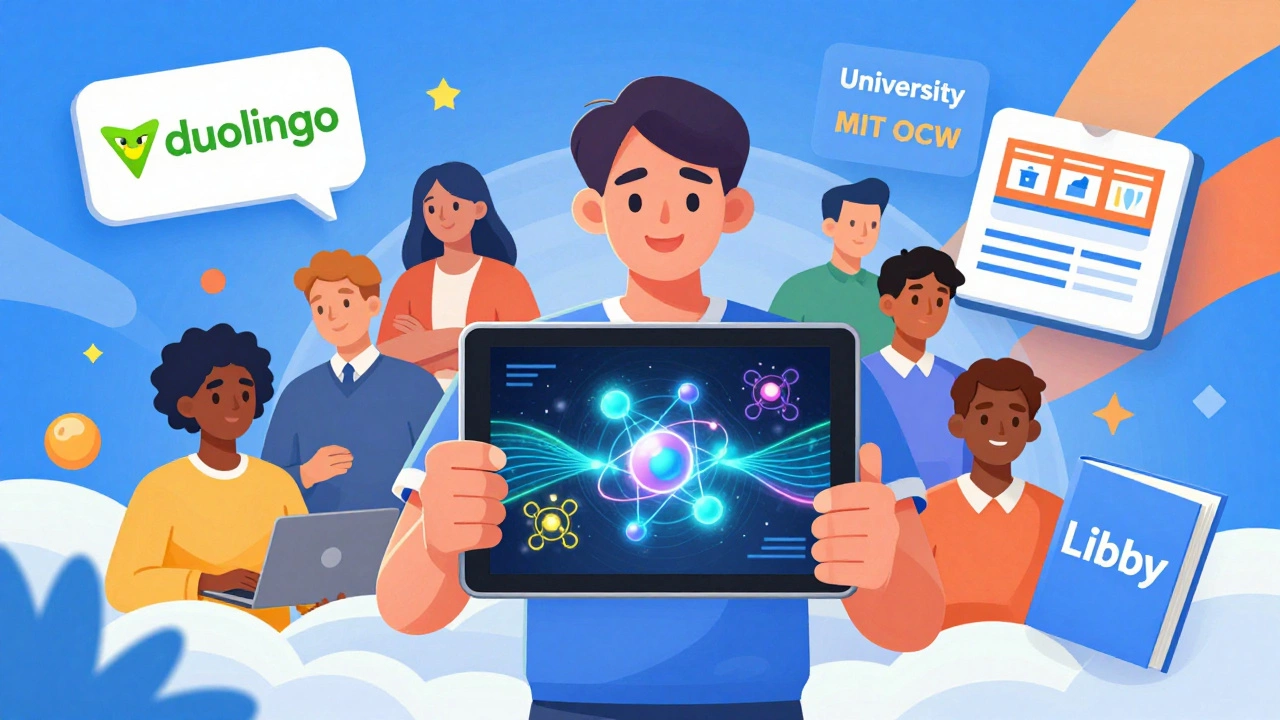
University-Level Knowledge for Zero Dollars
You don't need a $50,000 degree to learn how to code or understand macroeconomics. Platforms like Coursera and edX partner with universities like Harvard and Stanford. Here is the pro tip: always look for the "Audit" option. When you click enroll, look for a tiny link that says "Audit this course." This gives you access to all the videos and readings for free. You won't get a fancy certificate to post on LinkedIn, but the knowledge is exactly the same.
If you want to go even deeper, MIT OpenCourseWare (OCW) is a legendary resource. It isn't a polished "app" in the gamified sense, but it is a massive repository of actual MIT course materials. You can download lecture notes, assignments, and exams from some of the best professors in the world. It's raw, academic, and completely open.
Hidden Gems: Libraries and Open Archives
We often forget that the most powerful free educational tool is the local library. If you have a library card, you can download the Libby app (formerly OverDrive). Libby connects your library card to a digital catalog, allowing you to borrow ebooks and audiobooks for free. Instead of paying for an Audible subscription to learn about history or psychology, you can simply borrow the digital copy from your city's library.
Another resource for the curious is Project Gutenberg. While not an app in the modern sense, it's a digital library of over 60,000 free ebooks. These are books where the copyright has expired. If you want to read the original works of Plato, Jane Austen, or Mark Twain, you can do it here without paying a cent.
How to Spot a Fake "Free" App
To avoid wasting time on apps that eventually ask for money, use these heuristics. First, check the "About" section. If the company is a 501(c)(3) non-profit, the odds of it being truly free are high. Second, look at the reviews. If you see a flood of complaints saying "It was great until I hit the 5th lesson and they asked for $20," run away.
Third, be wary of apps that use "energy" or "lives." These are psychological triggers designed to make you pay for more time. A truly educational tool focuses on your mastery of the subject, not on whether you have enough "coins" to unlock the next chapter.
Is there an app that is 100% free with no ads?
Yes, Khan Academy is the best example. Because it is a non-profit funded by donors, it doesn't use ads or subscriptions to make money, meaning the entire experience is free and uninterrupted.
Can I get a free certificate from these apps?
Generally, no. Most platforms like Coursera or edX provide the knowledge for free (via auditing), but they charge for the verified certificate. However, some government-funded initiatives or specific non-profit courses occasionally offer free certifications.
Are free apps as good as paid ones?
In many cases, they are better. Resources like MIT OCW or Khan Academy are created by world-class experts and institutions. Paid apps often spend more on "gamification" (making the app feel like a game) than on the actual quality of the curriculum.
How does Duolingo make money if it's free?
Duolingo uses a freemium model. They make money through advertisements shown to free users and through monthly subscriptions for "Super Duolingo," which removes ads and provides unlimited hearts.
What is the best free app for learning to code?
While many have paid tiers, FreeCodeCamp is a fantastic non-profit resource. Though primarily web-based, it's the gold standard for free, project-based coding education. For an app experience, check out the auditing options on edX for computer science courses.
Next Steps for Your Learning Journey
If you're just starting, don't try to download ten apps at once. Pick one goal. If you want to improve your math, start with Khan Academy. If you want to learn Spanish, go with Duolingo and supplement it with HelloTalk. The biggest hurdle to free learning isn't the cost-it's the discipline. Since you aren't paying for the course, it's easy to quit. Set a schedule, use a habit tracker, and treat your free education with the same respect you'd give a paid university degree.